
Stepping into Rem Koolhaas’s legendary essay “Junkspace” is a disorienting experience. Existing in a liminal space somewhere between prose poetry and art manifesto, Koolhaas’s words on the state of modern architecture and building design boldly challenge the reader from the onset. One doesn’t need to read a single word to find its 16 pages of justified text, lack of paragraph breaks, and unconventional punctuation, visually arresting. Moving further into the text reveals the content of the essay echoes the incongruity of the style. From its bizarre opening declaration that “Rabbit is the new beef” through to its concluding ellipsis, we immediately recognize that this is not a traditional essay, but rather one that pushes us past the boundaries of the mainstream to deliver its message.
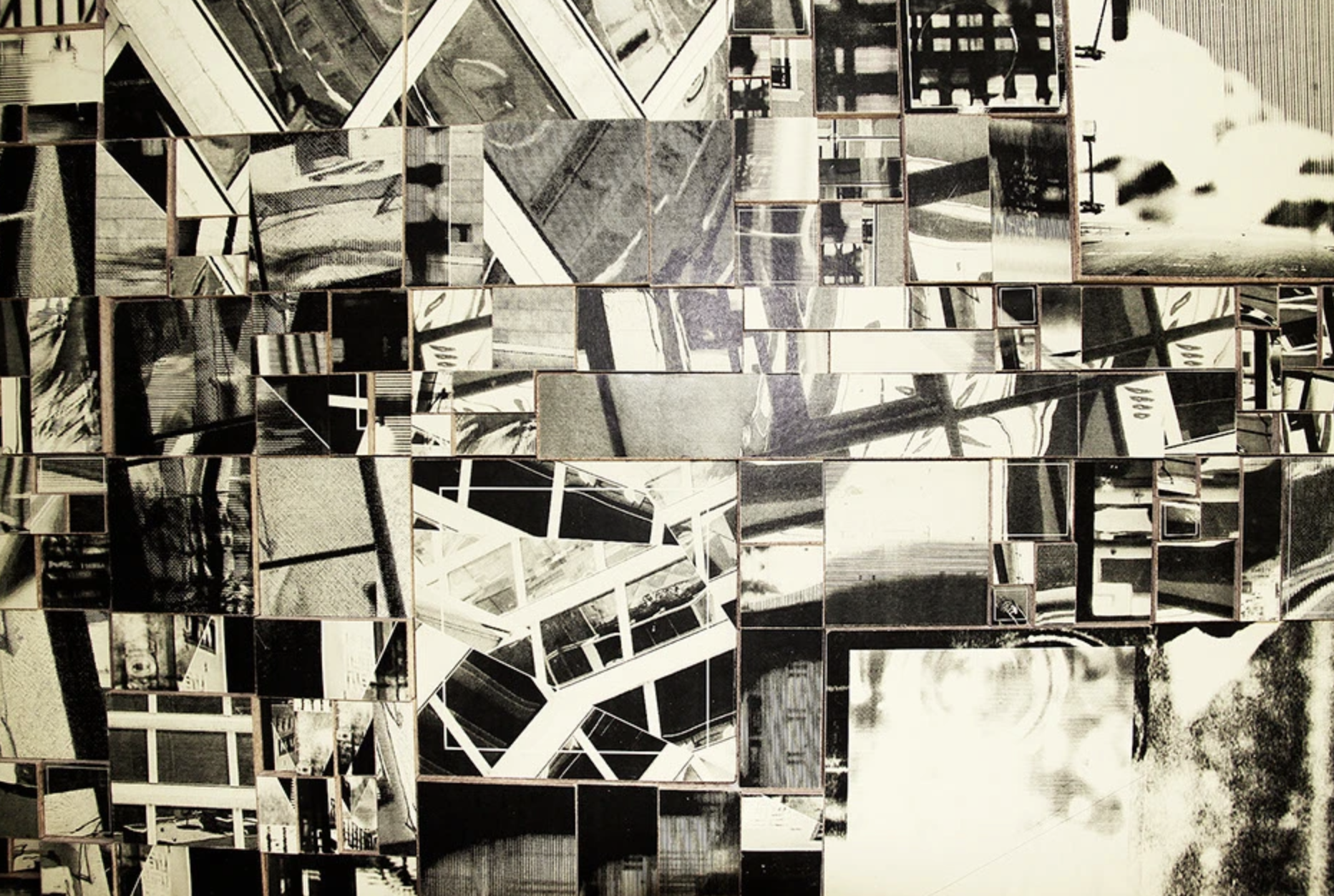
We begin with the one-word title “Junkspace,” which can be read as either uncharacteristically straightforward or frustratingly deprived of context. That this essay is where Koolhaas first introduced this word, which is entirely of his own making, strongly suggests the latter. Either way, the essay is an exploration of junkspace, a term Koolhaas has coined to refer to current trends in buildings and other designed spaces which he finds have devolved into a state of being somehow both function-driven and form-less, where commerce, artifice and expansion dominate all other motives.
The term is a play on the concept of “space-junk,” defined as the debris humans leave behind while exploring space. To Koolhaas, the inverse junkspace “is the residue mankind leaves on the planet”. It is the “fallout” that remains after the program of “modernization has run its course”. Koolhaas seems to lament that despite existing in a time when we are building more and have more freedom than ever before, “we do not register on the same scales. We do not leave pyramids”. We only leave junkspace. In other words, junkspace is the disappointing denoument of humanity’s progress.
Interestingly, while the majority of his words focus on physical structures (e.g. airports, casinos, shopping centers, theme parks, etc.), it is evident that Koolhaas sees this state of physical architecture as being symptomatic of a much more macro and theoretical problem. Koolhaas is an architect, but this is not an essay that is solely about architecture. Put broadly, junkspace is an all-encompassing condition of entropy, artifice, and ephemerality which Koolhaas sees seeping into nearly all aspects of modern life from language and dress to health, entertainment, and beyond.
It is a daring critique, particularly from someone who is not only involved in the proliferation of the very things he seems to deride, but who is in fact one of its star players or “starchitects”. One does not need to be familiar with the breadth and specifics of Koolhaas’s work to understand that as a working architect, everything he says in this essay about architects and architecture—and more widely about humankind—is also aimed at himself. The presence of this self-recrimation makes the message of junkspace even more critical.
And while there is much to say about the substance of his argument, it is the significance of the unconventional method of his form—and the way it contrasts with his message—that seems most significant.
Throughout “Junkspace,” Koolhaas shows rather than tells, immersing the reader in a kind of Berlitz Method lesson on junkspace, both through the words themselves and the physical structure (or lack thereof) of his essay. By eschewing typical conventions of grammar and style, Koolhaas effectively translates the disorienting and exhausting physical real-world experience of junkspace onto the page.
At first glance, the reader might be tempted to dismiss what seems like a rambling stream of consciousness, but closer examination suggests the chaos is a deliberate choice that goes beyond mere artistic prerogative. Koolhaas’s project is a curious and seemingly contradictory exercise; a critique of the decaying role of form and structure in architecture and life put forth through a dizzying lack of grammatical form and structure. There is method to his madness. There is function in the wildness of his form. Put more simply, Koolhaas seems to be using the very same chaotic principles he’s identified as junkspace to teach us about the chaos and consequences of junkspace.
Koolhaas may be leading us on a Dante-like journey into disorienting territory, but he is a benevolent guide. In fact, he is kind enough to express his intention from the very beginning where he notes: “Because we abhor the utilitarian, we have condemned ourselves to a life-long immersion in the arbitrary....”. Accepting this, we see that “Junkspace” is not a futile rant; it is a deliberate teaching tool that uses unconventional methods necessitated by the very nature of junkspace.
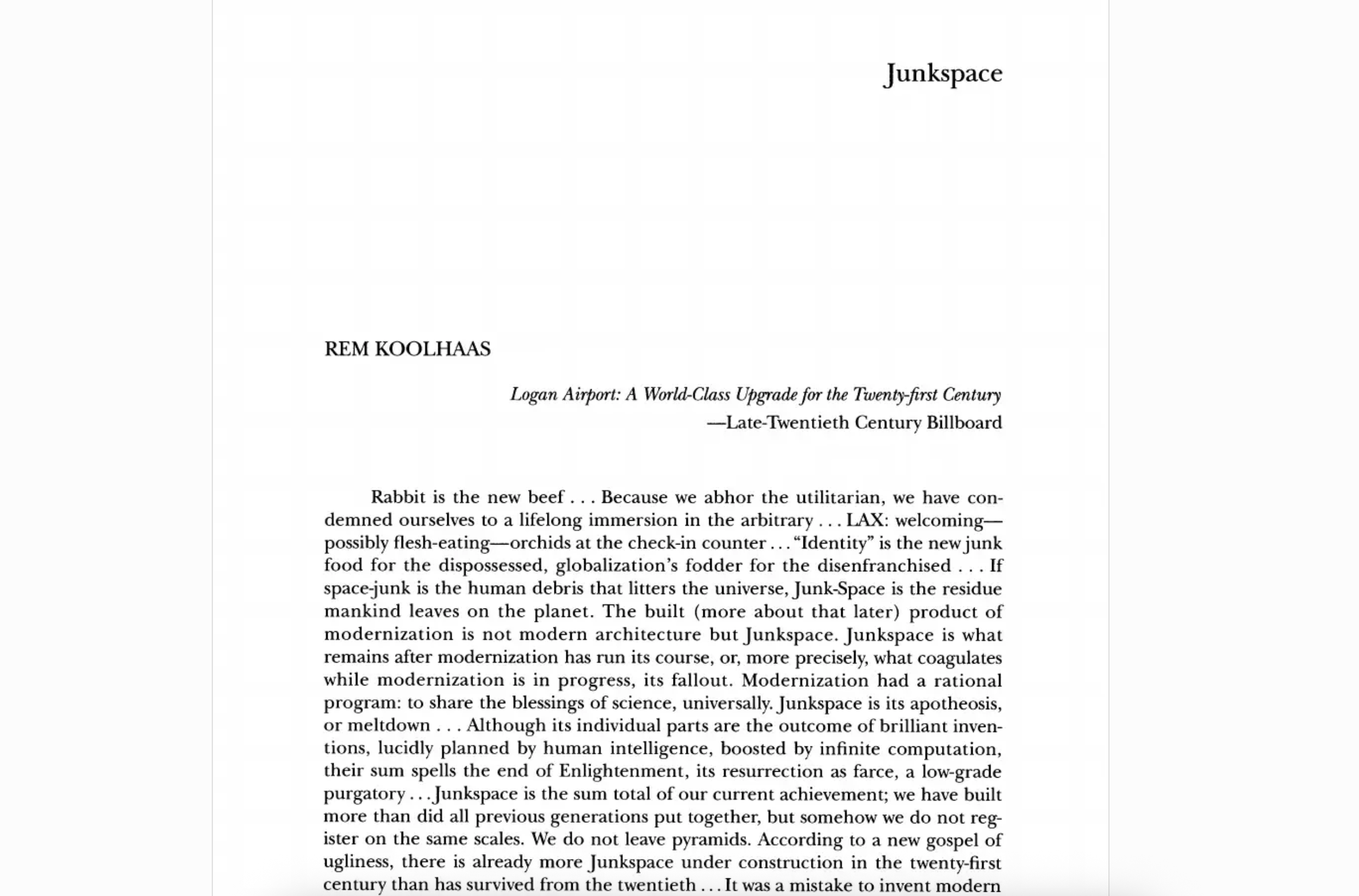
The most prominent of these methods is style, which is evident from our first encounter with the work. There is a disorienting visual wildness to “Junkspace.” The essay can be read in chronological order or the reader can choose to skip around, double back, turn around (intentionally or otherwise), much like the experience of navigating an airport, casino, or shopping center—all three examples of what Koolhaas deems junkspace. In “Junkspace,” there are no paragraphs or indentations. There are haphazard line breaks and punctuation. The text exists in a breathless 16-page justified block that continues and continues until it simply…drifts off. There is no white space for relief. No space to digest or absorb. “Junkspace” ends with questions and an ellipsis. And yet despite the madness, the committed reader still somehow arrives at the end with an “I know it when I see it” understanding of what junkspace is. Against all odds, the objective is reached.
This is perhaps because the feeling of overwhelmed confusion is hardly novel. In fact, Koolhaas asserts repeatedly through a maelstrom of anecdotal examples that such sensory overload is the new status quo of modern-day society (and consequently, junkspace). The reader who feels lost as they attempt to make sense of Koolhaas’s words has likely also experienced the same in the real world of maddening airport terminals, shopping malls, and theme parks that make you “uncertain where you are, obscure[s] where you go, undo[es] where you were”.
Koolhaas also leans heavily on the illustrative. Where one might typically expect to find thorough explanation supported with clarifying concrete examples, Koolhaas opts to avoid both and instead makes his argument with an additive series of images and ideas shared as lists, rambling asides, and standalone thoughts. Rarely does he offer much by way of explanation for any of these references, and his choice to occasionally expound upon some of them seems entirely arbitrary.
In one instance, a multi-sentence meditation on the strangeness of ballrooms:
huge wastelands kept column-free for ultimate flexibility. Because you’ve never been invited to that kind of event, you have never seen them in use; you’ve only seen them being prepared with chilling precision: a relentless grid of circular tables, extending toward a distant horizon, their diameters preempting communication; a dais big enough for the politburo of a totalitarian state, wings announcing as yet unimagined surprises—acres of organization to support future drunkenness, disarray, and disorder.
leads directly into a three-word thought “Or car shows…” which he immediately abandons and never mentions again. “What about car shows?!” we want to ask, but there is no time for we have already been shuttled into an entirely new thread about (fittingly) spider-less webs.
Occasionally, it is the text itself that is disorienting, warranting a faith-filled suspension of disbelief as we allow Koolhaas to lead us through to his message. There is, as he notes, “a special way of moving in Junkspace, at the same time aimless and purposeful”. The meditation on ballrooms above doubles as an example of this. Koolhaas’s theory about the strangeness of the ballroom is predicated on an idea that the reader has “never been invited to that kind of an event” in a ballroom or even seen one in use, assumptions which seem extremely unlikely. What, one might ask, are the realistic odds that a reader of this type of essay has never been to a wedding, awards ceremony, or professional conference? Or, at the very least, watched one on television? The dissonance is too obvious to not be deliberate.
It’s an unorthodox approach requiring an enormous amount of trust in the reader (and vice versa), and we must wonder why he would employ these methods which seem to contradict the crux of his argument. Why would Koolhaas spend 16 single-spaced pages bemoaning the convoluted chaos of modern-day life while simultaneously forcing us through an equally convoluted reading experience?
The answer is in the text itself where he explains that “anarchy is one of the last tangible ways we experience freedom”. Confronted with lawlessness in written work, the reader can identify what is obfuscated by artifice in the physical. Just like in real life where “nonconformity…can destabilize an entire Junkspace,” leading to disasters like “stampedes triggered by warring compartments of soccer fans” or “dead bodies piling up in front of the locked emergency doors of a disco,” or even less-tragic observations like free-flowing highways when people “have disappeared on vacation,” so can nonconformity on the page lay bare the problems of junkspace.
Koolhaas’s usage of immersion as a teaching tool is evidence of his belief that human nature is fundamentally at odds with junkspace, but it is only in the contrast that we notice its existence. In the reality of junkspace, there are too many distractions: “[t]he shiniest surfaces in the history of mankind.” But on the page, he understands that we simply cannot look away.
As an architect of privilege and platform, Koolhaas must know he has more agency against the proliferation of junkspace than this essay would imply, but by including himself in the critique he is underlining the extent of the problem and forcing us to understand the ways it extends far beyond one of architecture. All of which poses one final question, if there is so much to be learned from “Junkspace” on the page, what does Koolhaas want us to understand about “junkspace” in life?