
I’m endlessly seeking shortcuts. In an effort to buy back precious minutes lost to reasons both cognitive and cultural, I’ve gamified my commutes, perpetually scanning my environment for more efficient ways to get where I need to go. With the precision of a skilled hunter, I skip entire city blocks by cutting through semi-public buildings, calculate the risks of jay walking across thoroughfares, and shamelessly trample diagonally across beautifully manicured, but inconveniently placed lawns. Sidewalks become mere suggestions.
“Keep off the lawn” signs? Challenges.
My need to get where I need to go as expeditiously as possible always superseding the plans set for me by some distant figure. As creative as these choices may feel, these meanderings are not unique to me, but rather part of a centuries long tradition of living beings charting alternate paths.
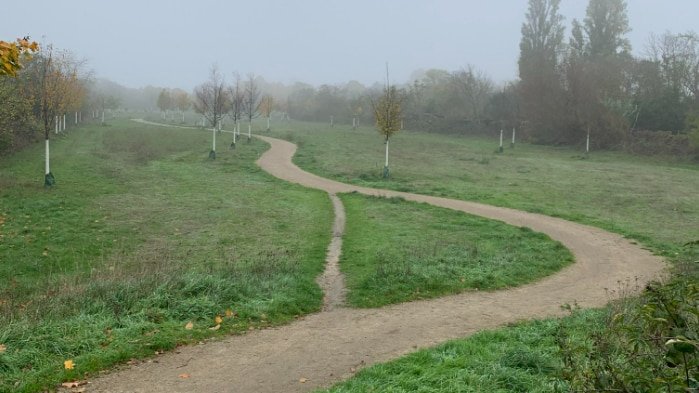
They’re called desire paths, an undeniably romantic name conveying sentiments of yearning both illicit and indulgent. At their simplest definition, desire paths—also known as desire lines—are natural unpaved pathways created by human inclination and instinct, rather than planning. It’s the worn dirt path cutting through a grassy college quad. A sandy shortcut leading down to the beach. The track of slushy muddy footprints slashing through an otherwise pristine blanket of white after a snowfall.
The visuals can be arresting, poignant, even humorous, serving to convey seemingly universal truths about animals and humans alike. To some, desire paths are found art waiting to be discovered in the most prosaic of places. An exquisite corpse created collaboratively by paws, feet, or bicycle tires motivated through equal parts impatience and curiosity. To others, the trampled lines take on deeper symbolic meaning representing everything from charming ingenuity and independence to civil disobedience, protest, and even anarchy. In every case, desire paths illustrate a fundamental tension between theory and practice, planning and usage, and the myriad ways humans relate to their built and natural environments.
Accordingly, the concept has captured the imaginations of enthusiasts around the world. On Reddit, more than 320 thousand followers of the r/DesirePath community (known as a “subreddit”) seek, share, and catalog snapshots of desire paths with the same sort of obsessive dedication as the most avid of birders. (In true desire path fashion, a separate r/DesirePaths subreddit of nearly 50 thousand created their own group because they felt the singular tense of the first group’s name wasn’t as intuitive.) Search terms for #desirepaths and #desirelines on Instagram bring up thousands of images and videos, sometimes paired with path-themed lines from poetry (Robert Frost and his diverging roads are a favorite) or inspirational cliches about “charting new territory” or “breaking new ground.”
Notably, while digital cataloging and sharing of desire paths is unique to our modern age, recognition of their informative value has existed for decades. In the late 1950s, self-taught urban theorist and activist Jane Jacobs advocated for a people-first or “the customer is right” approach to urban planning. To Jacobs, healthy cities are messy and organic products of evolution which function best when design is “bottom-up” or driven by the way its inhabitants actually use their spaces rather than the lofty ideals of politicians and planners. To Jacobs, “There is no logic that can be superimposed on the city; people make it, and it is to them … that we must fit our plans.”
Jacobs believed the only way those involved in the various aspects of urban design could understand what people truly wanted and needed from a city was through first-hand experience. Specifically, she encouraged the act of physically walking through a city to see how people were actively using the currently existing spaces, rather than simply relying on “the abstract logic of a few men.” For Jacobs, the citizens of a city were its true experts, and walking was the only way planners could properly identify the ways “many of the assumptions” on which they’d determined their projects were, in reality, “visibly wrong.”
This type of firsthand data is precisely what desire path advocates feel is so valuable about these renegade walkways. It’s not really about the path itself, but the desire that led to its creation; the unique and varied impulses that caused individuals to seek an alternative to what was available or offered. As noted in The Guardian by architect Riccardo Marini, “Desire lines present evidence about movement” and paying attention to the data they share is akin to the act of “listening to a place.” Beyond seeing them as mere objects of curiosity, architects and urban planners like Marini advocate for using the evidence revealed by desire paths to inform the work of city planning in a way that centers its citizens.
This people-first method of planning has been particularly appealing to those involved with the design of college campuses, which often exist like mini self-enclosed cities; a microcosm of people living, working, and playing within a defined space. Some of the most well-known real-world examples of these theories can be found at the universities of Michigan State and Ohio State, both of which opted for a unique approach of delaying the construction of paved pathways until the faculty, students, and other members of the community had time to use the space. The planners then used the trampled footpaths as guides for determining where the permanent paths would go.
Cornell University used a similar method to create their “Arts Quad” (where crisscrossing pathways connect the surrounding buildings), as did the National Institutes of Health for its headquarters in Bethesda, Maryland. A popular, but most-likely apocryphal story even claims Columbia University’s 13th President, Dwight D. Eisenhower, encouraged a similar approach for the Morningside Campus, but the evenly spaced and sharp 90-degree angles of the school’s paved pathways suggest otherwise. A distinct characteristic of desire paths, after all, is that they rarely follow such strict geometric parameters, instead favoring slightly more haphazard diagonals or sloping organic curves. The suggestion that human feet gravitate toward these irregular shapes which differ from standard paved pathways is itself evidence of Jacobs’ theory that logic cannot be superimposed on a city.
It is easy to see why this romantic method championing the wishes of the individual can seem so appealing to those seeking to design cities and spaces that best serve its residents, but it’s important to note that this seemingly populist approach also faces challenges when transitioning from theory to practice. Desire paths formed by individuals trampling across lawns or slipping through hedges might help elucidate where access is desired by some, but what about the people who, for various reasons, are unable to chart their own course with the same ease, comfort, or safety? In advocating for their people-first approach to planning, theorists like Jane Jacobs and Riccardo Marini, or the Redditers celebrating the civil disobedience of desire paths, overlook the glaring fact that not everyone is able to physically participate in society in the same way.
To begin with, Jacob’s invocation to “get out and walk” ignores the glaringly obvious fact that not everybody physically can walk, thereby summarily barring individuals with varying levels of disability or impairment (even temporary ones) from participating in this activity. Returning to the example above of the universities who delayed creating paved paths until the students had a chance to use the campus for a few semesters, leads one to wonder what happened to the students or professors who were forced to navigate the irregular grassy hills and lawns with canes, wheelchairs, or crutches? The seemingly fascinating plan also ignores the traditional differences of attire and footwear between genders. As any woman who has felt the heels of her stilettos slowly sink into the grass during an outdoor wedding ceremony can attest, a man in a pair of trousers and flat shoes will always have a far easier time charging through an unpaved lawn than a woman in a dress and heels. Truthfully, able-bodied individuals wearing even the most practical types of footwear would still struggle to make multiple hikes to class, work, and meals through rain, mud, sleet, and snow (particularly that Ann Arbor snow!).
In their essay, “Crip Mobility Justice,” disability justice activist Aimi Hamraie wrote about their experiences as a person with disabilities that are “not always apparent to others,” taking part in efforts to transform car-centric Nashville, Tennessee, to a more “healthy” city with increased bicycle lanes and public transportation. As an observer in this process, Hamraie joined in on site visits and field trips, but quickly found that their “particular ways of using built environments were not anticipated” by their colleagues involved in the planning or design. Hamraie’s limitations in this part of the process made it clear to them that “if cities are not already accessible, opening them up to active transportation does not make it safe and easy for participants who are already marginalized, whether on the basis of disability, age, race, or gender.” In much the same way, relying on the Desire Path data gathered from already-active users of an inaccessible space will lead to creating new spaces that continue to ignore the needs of the those who were not able to participate in the process because the difficulties were too insurmountable. This essentially creates a snowballing effect of continuous passive disenfranchisement where people are excluded not out of active malice or intent, but simply because they are not being considered to begin with.
The premise is further complicated when you consider less obvious limitations of gender and race as they relate to comfort and safety. As Mabel O. Wilson explains in her essay “Mine Not Yours,” Black and brown individuals are regularly subject to levels of hypervigilance and harassment simply for existing in bodies that are viewed as suspicious due to centuries of deeply ingrained white supremacy. Wilson references the “spate of incidents, almost daily, where white Americans have called law enforcement on black Americans who were engaged in the ‘criminal acts’ of sitting in a Starbucks waiting for a meeting, napping in a common area at a Yale University graduate dormitory, walking a stroller in a public park, checking out of an Airbnb…” Given this reality, it stands to reason that a cisgender white man may not think twice about taking a hidden desire path through a semi-private lawn or secluded parking lot to save time en route to his destination, while a Black man or a woman of any race might view the same activity with a starkly different level of caution. For the latter two, the longer, less-convenient route might feel like a safer option helping them avoid instances of discomfort, harassment, violence, or even death.
In her book, Wanderlust: A History of Walking, Rebecca Solnit says: “the paths I trace are not the only paths.” It is a poetic way of expressing the fundamental truth that part of the human experience is never truly know how others live the same events. Recalling an incident where a faulty key kept making it difficult to enter the house provided for her during a work trip, Wilson wrote:
“You knew instinctively that a neighbor or passerby might see you and assume you (a black woman ) were somewhere you did not belong (an iconic private house in a white neighborhood.) That’s one of the incessant maneuvers that racism deploys to dehumanize you—it routinely puts you in your place—mentally and physically.”
When checking in with her colleague about the key, she was met with a casual response that laid bare the mental ease of white privilege. As a Black woman, Wilson has knowledge and understanding of what such a seemingly minor incident could lead to. For her, the sticky key meant fear, stress, and heart-racing anxiety; to her colleagues, it was a mere annoyance or something to just “get used to.”
These nuances are often even lost on the people who know us best. A few weeks after our second wedding anniversary, my husband, Eugene, and I adopted a two-year-old shih-tzu named Hudson. Like all new pet owners, there were a number of surprises those first few months, but most striking of all was the realization of just how different my husband and I experienced the simple task of walking the dog. For my husband (a tall white male), walking Hudson was a straightforward activity: he’d simply attach the leash, grab his keys, and head out, returning with a happy dog and nothing of interest to share.
As a Latina woman, my experience was always significantly more stressful. Each time I returned from walking Hudson around our uptown Manhattan neighborhood, I had a stories about groups of catcallers who shouted crude comments about my body, men who tried to join me on my walk, and those who would aggressively block my passage to get my attention when I didn’t respond. One afternoon, when I returned home exasperated and complaining about yet another unpleasant experience, my husband shook his head, befuddled. “I don’t get it,” he said. “Nobody ever says anything to me out there.”
This chasm of understanding is at the heart of why one-size-fits-all concepts in city planning will always exclude the voices that are needed most. There’s an inherently blinding quality to privilege that no level of good intention can surpass without actively seeking diverse perspectives. Interestingly, Jacob’s frustrations with the out of touch nature of “the abstract logic of a few men” are the same critiques one might make about her own arguments and the arguments of anyone who looks at the problem of urban planning through a single lens. As bold as Jacobs’ ideas were for her time, they were also very much abstract ideas based on the assumptions and singular logic of one able-bodied white woman. Ultimately, any approach to urban planning that aims to meet the needs of all who exist within the environment, must find a way to consider the desires of everyone, even those who are unable to mark their own paths.