
“There was a time when I would rather have had you by my side than any one of these words; I would rather have had you by my side than all the blue in the world.” - Maggie Nelson
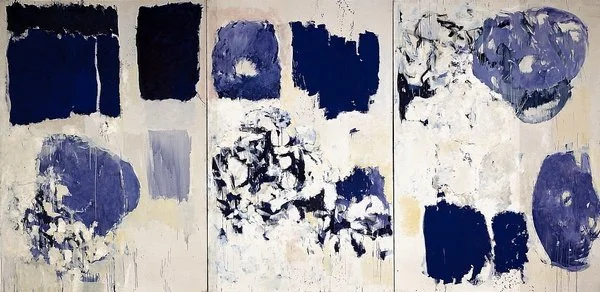
JOAN MITCHELL: LES BLUETS (THE CORNFLOWERS), 1973
I chose Bluets because I wanted to learn how to let go of a dream.
In the first version of that sentence, I wrote: a dream that no longer fit, but then went back and removed that part because it’s not really that the dream doesn’t fit; it’s simply that I want to wear something else, regardless of how good the dress looks.
(Then again, multiple things can be true because I can also think of all the ifs that would have made me want to keep wearing that dress.)
I try to explain this to my best friend, but he doesn’t understand because so many of the ifs went his way. Our conversation keeps getting interrupted because two TV networks are in a bidding war over one of his projects. When he returns to the table I say: it doesn’t make sense to you because the same people who keep offering you more, keep offering me less.
The makeup artist I’ve worked with for years says, “I’m just surprised what you’re studying has nothing to do with food.”
She is not the only one to say this. Again and again people assume that when I say I’ve gone back to school it’s for something to do with food: food science, food studies, nutrition, public health. Others hear Columbia and assume it’s Journalism. When I tell them actually, no, it’s art, they look so confused.
One of the problems of changing your outfit at this point in life, is that people stop recognizing you.
But then again, I feel like if they are so surprised it’s because they weren’t paying attention. How much of a misunderstanding is the fault of the misunderstand-er?
In another version of that sentence, I wrote: how to let go of a dream without feeling like it was all a waste, but immediately went back and changed it because I already know it wasn’t a waste. The waste would be in staying.
I remember once reading an article about a successful woman who struggled with overeating because she couldn’t bear to throw food away. She had grown up not knowing when her next meal would come, and even though she was now financially secure, the feeling of fear and lack never left. She would eat all the leftovers at the end of the night, take home stale breads and pastries from the office, clean off her family and friends’ plates when they went out, even eating things she didn’t like or that were questionably safe just so that it wouldn’t end up in the trash. She explained that it all changed for her when a doctor pointed out that eating to a point of discomfort—to the point where you make yourself physically sick—can also be considered a form of waste. A day of life spent doubled over in pain retching into a bucket is even more of a loss than an old carton of milk. The body can only absorb a certain amount of nutrients, it can only use so much energy. Even pleasure has its limits.
There are many kinds of waste.
(Or maybe we reframe it. Maybe it’s not about what we use or lose or spend, but rather what we choose to gain.)
“I mean the time is going to pass anyway,” I keep saying to the people who can’t seem to understand why I would undertake all this at this point.
There are no accidents. There are no coincidences. There are no mistakes. Nothing is ever lost. Nothing is a waste. Everything is a lesson. Even if the lesson is simply no. Not this. Not anymore.
I chose Bluets because a story rooted in romantic heartbreak made far more sense to me than all the career self-help books in the world. This is not about finding a new job or rewriting my resume or changing anything other than the dream in my heart.
What also makes sense to me: a cord-cutting. The spiritual practice of breaking energetic ties to rebalance and move forward. I pay an Instagram astrologer $11.11 for a virtual cord-cutting workshop, and spend half an hour with my eyes closed visualizing the old dream as cords I unplug from each of my chakras. He explains that these ceremonies usually ask you to imagine cutting the cords with a pair of imaginary golden scissors, but that cutting leaves threads and remnants. His method is cleaner. I picture the cords like the retractable ones on my iron and hair dryer, unplugged and zipped away.
(I looked up cord-cutting to see if it’s typically hyphenated or spaced and am reminded the phrase also exists in the TV industry to refer to viewers who cancel their cable subscriptions, essentially unplugging themselves from television. I am delighted by this parallel and add it to the archive for future reference.)
The other thing that makes sense to me about cord-cutting (the spiritual version) is that it’s not really about eliminating anything other than the connection or the energetic pull. The job or person or place or event may still continue to exist in your life; it’s only your feelings that will change.
In 199, Nelson says: For to wish to forget how much you loved someone—and then, to actually forget—can feel, at times, like the slaughter of a beautiful bird who chose, by nothing short of grace, to make a habitat of your heart. I have heard that this pain can be converted, as it were, by accepting “the fundamental impermanence of all things.
I worry that partly what I’m doing is trying to convert the inevitable to justify the disappointment. (And if so, so what?)
I tell my friend in the bidding war, it’s not that I want to stop doing TV, it’s that I want to stop wanting to do it. “Are those different things?” They’re very different things.
In hindsight, it should have occurred to me sooner that choosing to spend time thinking about Bluets would alter the color of my days. That I would expect anything less than a fixation on the color blue from a meditation about a fixation on the color blue is, frankly, a bit naïve. And yet, that is what happened.
Columbia’s campus is blue blue blue. The PBS logo is also blue. My dog rolls over for a belly rub and his blue neuter surgery tattoo dances as he wiggles back and forth. In an art history class, we spend a lesson talking about the way lapis lazuli was mined in Afghanistan, then ground to create ultramarine pigments. The blue used for the Virgin Mary’, Vishnu, Kali—the lush robes and textiles of the wealthy and royal and divine.
Because of the election, I stop wearing my favorite color red on TV so as to not give the wrong impression, instead opting for various shades of cobalt, turquoise, navy, cerulean. I start an imperfect list of the blue things, but there are so many that I revise the project and focus on blue-related accidents: A broken blue glass. Spilled soup on my dress. The store sends a dozen blue eggs because they’re out of the regular kind. There are no seats left at the popular blue restaurant. The museum is closed the day I need to look at a blue-edged painting for a class.
The election results come in and there isn’t enough blue.
I skip this year’s batch of intentionally bad Christmas movies and return to old favorites which are now all tinged with blue. There is a scene in the first Bridget Jones film where she uses a piece of blue twine to tie a bundle of leeks while making soup, an ill-advised choice that turns her pot of vichyssoise a horrifying shade of periwinkle. “There aren’t enough blue foods,” jokes one of her dinner party guests.
It's a truth I deal with each summer when trying to come up with new ideas for Fourth of July-themed cooking segments and last-minute Labor Day BBQ ideas. My producers want things reminiscent of the American flag and reject my intentionally alternative suggestions. They send me example TikTok links I can’t open because I do not use the app.
For most people who do what I do it isn’t a problem to patriotically arrange berries on a cake and stir M&Ms into cookie dough, but I kick and scream the whole way through, making it harder than it needs to be because I’m bored with the way that for three months out of the year, every recipe is a permutation of blue potatoes, blue corn, blueberries, and blue food coloring.
It’s not the only thing I’m bored of.
Bluets is the blue twine in my soup.
I chose Bluets because I want to think about the things I cannot do with food.
Same sentence, revised meaning: I chose Bluets because I want to think about the things I cannot do with food.