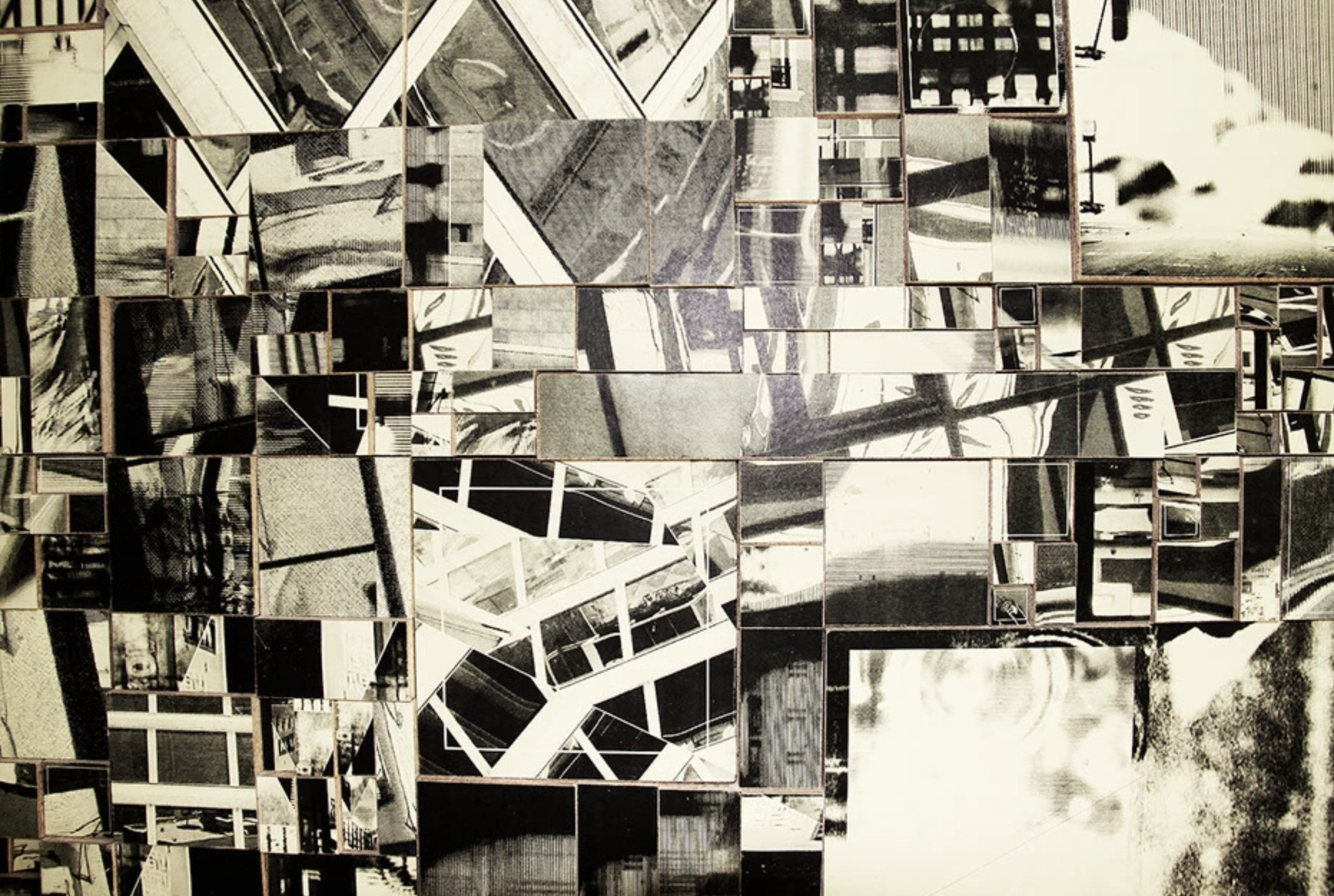
Stepping into Rem Koolhaas’s legendary essay “Junkspace” is a disorienting experience. Existing in a liminal space somewhere between prose poetry and art manifesto, Koolhaas’s words on the state of modern architecture and building design boldly challenge the reader from the onset. One doesn’t need to read a single word to find its 16 pages of justified text, lack of paragraph breaks, and unconventional punctuation, visually arresting. Moving further into the text reveals the content of the essay echoes the incongruity of the style. From its bizarre opening declaration that “Rabbit is the new beef” through to its concluding ellipsis, we immediately recognize that this is not a traditional essay, but rather one that pushes us past the boundaries of the mainstream to deliver its message.
We begin with the one-word title “Junkspace,” which can be read as either uncharacteristically straightforward or frustratingly deprived of context. That this essay is where Koolhaas first introduced this word, which is entirely of his own making, strongly suggests the latter. Either way, the essay is an exploration of junkspace, a term Koolhaas has coined to refer to current trends in buildings and other designed spaces which he finds have devolved into a state of being somehow both function-driven and form-less, where commerce, artifice and expansion dominate all other motives.
The term is a play on the concept of “space-junk,” defined as the debris humans leave behind while exploring space. To Koolhaas, the inverse junkspace “is the residue mankind leaves on the planet”. It is the “fallout” that remains after the program of “modernization has run its course”. Koolhaas seems to lament that despite existing in a time when we are building more and have more freedom than ever before, “we do not register on the same scales. We do not leave pyramids”. We only leave junkspace. In other words, junkspace is the disappointing denoument of humanity’s progress.
Read MoreI’m endlessly seeking shortcuts. In an effort to buy back precious minutes lost to reasons both cognitive and cultural, I’ve gamified my commutes, perpetually scanning my environment for more efficient ways to get where I need to go. With the precision of a skilled hunter, I skip entire city blocks by cutting through semi-public buildings, calculate the risks of jay walking across thoroughfares, and shamelessly trample diagonally across beautifully manicured, but inconveniently placed lawns. Sidewalks become mere suggestions. “Keep off the lawn” signs? Challenges. My need to get where I need to go as expeditiously as possible always superseding the plans set for me by some distant figure. As creative as these choices may feel, these meanderings are not unique to me, but rather part of a centuries long tradition of living beings charting alternate paths.
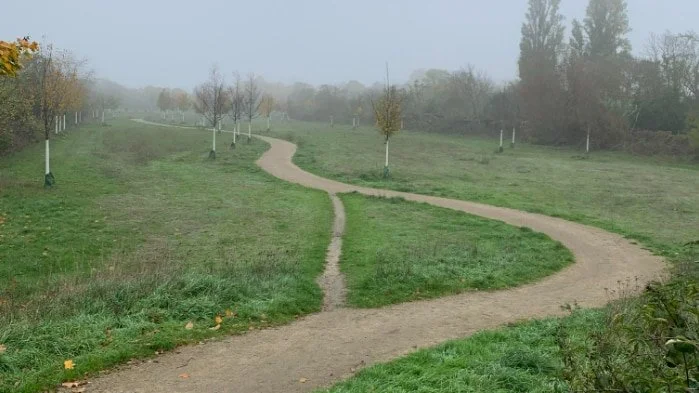
They’re called desire paths, an undeniably romantic name conveying sentiments of yearning both illicit and indulgent. At their simplest definition, desire paths—also known as desire lines—are natural unpaved pathways created by human inclination and instinct, rather than planning. It’s the worn dirt path cutting through a grassy college quad. A sandy shortcut leading down to the beach. The track of slushy muddy footprints slashing through an otherwise pristine blanket of white after a snowfall.
The visuals can be arresting, poignant, even humorous, serving to convey seemingly universal truths about animals and humans alike. To some, desire paths are found art waiting to be discovered in the most prosaic of places. An exquisite corpse created collaboratively by paws, feet, or bicycle tires motivated through equal parts impatience and curiosity. To others, the trampled lines take on deeper symbolic meaning representing everything from charming ingenuity and independence to civil disobedience, protest, and even anarchy. In every case, desire paths illustrate a fundamental tension between theory and practice, planning and usage, and the myriad ways humans relate to their built and natural environments.
Read More