PART I: Science
Untitled, 1994, Peter Fischli and David Weiss
Allergies are caused by an overreaction of the immune system.
That’s the part of the definition that stayed with me when I looked it up, immediately fixating on the idea of my immune system going full telenovela in response to a couple Tylenol. As far as allergies go, it’s not a bad one to have. It’s certainly far easier to avoid than peanuts or gluten or puppies or lobster. I just take Advil, instead. Or use a heatpad. My Tylenol overreaction is fairly tame; a crimson flush that begins in my neck before spreading up and down until a good third of the skin on my body matches the signature red cap. My temperature rises to match the red (flaming! burning!) and my ears begin to ring. This latter symptom causes the majority of the panic, even knowing I’m only two Benadryl and a couple hours away from feeling normal again, there is always that fear that this is just who I will be now: a hot-to-the-touch tomato with tinnitus.
It’s been ten years since my last overreaction, but I still feel the panic when I look at this facsimile of a bottle (is it hollow, I wonder? Are there polyurethane pills inside? Is there a parallel polyurethane world where I experience polyurethane reactions?)
The last time this happened it was my fault, or so I was made to believe. I’d forgotten to mention relatively new-to-me allergy when I checked in to the ER with a slashed leg, and absentmindedly downed the little cup of pills a nurse handed me. It took me a moment to realize what was happening and then another moment to sort out whether it was worth interrupting the doctor sewing neat stitches on my calf to inform him that I was actively overreacting and would need him to pause the needlework and get me a dose of the aforementioned rhyming antidote. I ultimately decided that yes, it was more urgent, and politely tapped him on the shoulder.
What I remember most is how irritated he was with me, annoyed that I hadn’t informed anyone of the allergy and when I clarified that I had only ever experienced the overreaction while visiting my best friend in Edinburgh where the pill is called Paracetamol and I had (wrongly, yes, I’m aware now) assumed that it was only the British version that was an issue for me.
At home, I keep a bottle for my husband, dispensing them when he has a headache or a fever or some kind of injury. I took a thick black Sharpie and scribbled all over the white and red: “ALEJANDRA IS ALLERGIC. For Eugene ONLY.” I started this during Covid lockdown envisioning a possible reality where I’m too ill to say no. “These look like murder pills,” my husband says looking at the violently defaced bottle. He’s not wrong, but I’m not taking chances.
Even if the bottle is solid. Even if there aren’t any pills inside, polyurethane or otherwise, this bottle is not harmless.
The looking makes me think. The thinking makes me panic. I am, actively, overreacting.
PART II: Music
Untitled (Rotterdam), 2003. Peter Fischli and David Weiss
Peering through the frosted glass door, the gallery looks closed. It’s a few minutes past five and only a handful of people remain on the street, ducking into doors one or two at a time. Most have wandered off to meet friends for happy hour or settle in for an early dinner. Inside, the light feels dimmer than it should be, but I assume it’s intentional and say nothing.
Moments later, a mother hesitates at the door before walking in with her young son. “We thought you were closed!”
The gallery sitter apologizes. I catch only bits of it: Something about how the lights keep flickering. Less annoying to keep them off. It’s better when it’s sunny, but the clouds are thick today.
“We’re just scraping by without light” (I write this part down.)
The boy races to the opposite side of the gallery. The mom laughs like a bell and follows him. He’s free in his movements yet knows enough not to touch.
The brightest part of the room is in the center under a paneled glass skylight that sits directly above a polyurethane copy of a light bulb box, flooding it with natural light. I wonder again if it wasn’t intentional. Removing utility and then pairing it with a need.
The suggested bulb in the box is a light and it never goes out. The bulb in the box is a light and it never goes on.
PART III: Philosophy
In the Studio, 2008, Peter Fischli and David Weiss
Somehow out of everything in this room, this duck is the most useful. Utility (a teapot, I assume?) removed, but utility (humor? novelty?) remains. The hat. The cigarette. A dull shade of un-fired matte clay, like the pots I abandoned when I dropped out of a weekend pottery class. Bending over the wheel exacerbated the pinched nerve in my spine, but sometimes I pass by the studio on the way to the bakery and feel a tinge of regret about the little pieces imagining them still sitting there on a shelf labeled with my name.
There is a kind of life to this duck, unlike the peanuts, the brush, the milk, the mug. The Hadith proscribes the drawing of animate objects, and in this inanimate room, I understand how one could look at the little eyes, the open beak, the tightly folded wings, and see the potential below its surface, the threat of life daring through. To neutralize the energy the duck must be defaced or decapitated, and the longer I look at him, the more heartbreaking the idea becomes. I believe energy attaches itself to objects.
In Chinese cooking the poetic term is “breath of the wok,” which refers to the searing heat of the pan, but also to the singularity of the flavor it imparts. In a pan passed down from one generation to the next, the breath remains.
The objects in this room are not passed down; they have no breath. But the longer I stay, the longer I risk the energies that appear. The duck is a friend. The Tylenol, a source of panic. The painters tape peels off a wall in my head. The paint rolling off like tubes under the faucet. The peanuts shells crunch under my feet. The dog’s water bowl needs to be filled.
(Is the duck thirsty? And when did it become a he?)
PART IV: Art
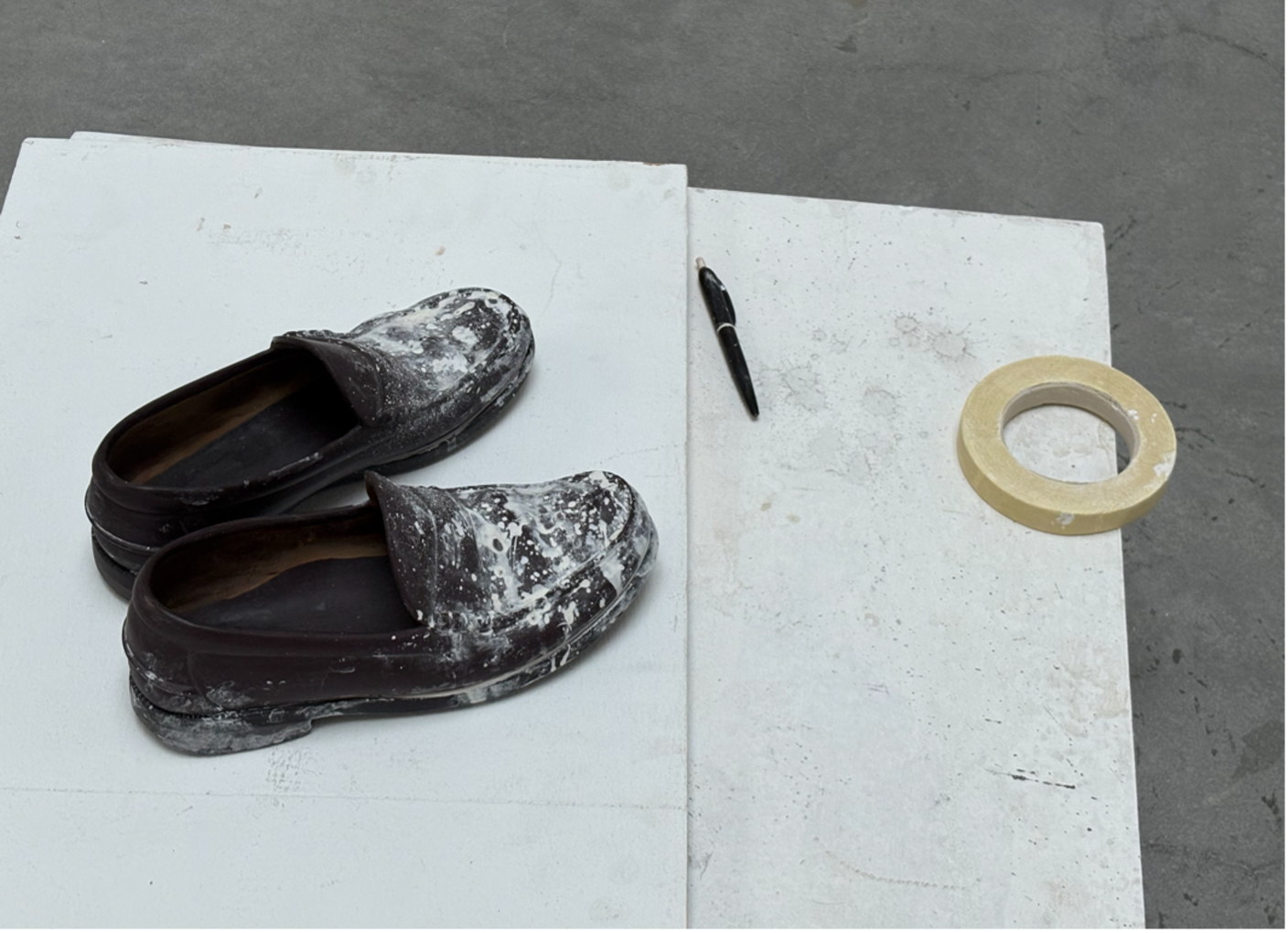
Untitled 1994 - 2013, Peter Fischli and David Weiss
Here in the gallery, a pair of polyurethane shoes covered in paint sit by a roll of painter’s tape and a pen. These shoes are meant to be looked at, not worn; tools of the trade that speak to the act and labor of art without ever showing the work itself.
I’ve seen this image before.
In the summer of 1950, the photographer and filmmaker Hans Namuth approached Jackson Pollock saying he wanted to capture him at work. Though he had to be coaxed into it by his wife, the artist Lee Krasner, Pollock agreed and the pair proceeded to spend most of the summer and into the early fall working together. At first, Namuth photographed Pollock in his studio, but soon felt that he wanted something that would better capture the artist in motion: a film.
The film opens with Pollock signing his name in black paint on a glass sheet balanced over the camera, then moves on to a wide shot of the artist taking a seat and changing into his painting shoes—the ones he always wears as he pours and swings and drips paint onto a canvas. The camera moves to the shoes, the shot tight but shaky. It’s a pair of work boots, black and slumped from wear, with loose laces and a tongue that dangles out. The kind of shoes you can easily slip in and out of. Shoes of utility. They are covered in paint; a work of art unto themselves.
Fifty years later, the actor Ed Harris portrayed Pollock in a film he also directed. This scene with the shoes is reenacted in the movie, where Harris as Pollock takes a seat and begins to pull on the shoes before the actor playing Namuth admonishes him—not so fast, he says. Do it again. Slowly. The take repeats a few times until Pollock is furious. Namuth has turned Pollock into the art and he can’t handle it. He feels like a phony acting the part of an artist. He pours himself a drink, summarily ending three years of sobriety.
Today you can drive out to the Hamptons to visit Pollock’s house where he and Krasner painted, where Namuth photographed him at work, where Ed Harris filmed the 2000 movie. To enter the studio they hand you little ballet flats in shades of neon yellow and Kelly green to slip on your feet to protect the paint-splattered floors from your unremarkable stains.
You’re here to see the mess of a genius.
At the house, a pair of paint-covered boots is on display, but these belong to Krasner, who continued her work in his studio after his death. Tourists photograph the boots and their own neon slipper-covered feet standing on Pollock’s drips. The detritus of the artists as much an attraction as the works themselves. Like the shoes here in this studio, they are no longer shoes to be worn. They are only shoes to be looked at.
PART V: Literature
Untitled (Rotterdam), 2003. Peter Fischli and David Weiss
For years, the story was misattributed to Hemingway, supported by one of the many often-apocryphal myths about bar boasts, bets, and brawls that form the writer’s legend. In reality, the six-word story predates Hemingway’s writing career, appearing in print when he was still just a boy.
The concept of being able to convey a complete story with just a few words makes sense in a space like this where items devoid of purpose seem ready to fill in the gaps. There is a sadness to the child-sized pair of boots. They sit unused, just like not-Hemingway’s baby shoes. And while they are not for sale, they stand ready to be given a purpose—a story, a meaning.
Unlike the other more thoroughly paint-splattered shoes and gloves, the boots are relatively pristine with only a few little drips. These aren’t boots worn by a child actively engaged in the mess of art or play. They’re boots that happen to be in the room, a spirit in the background while the artist works.
More memory than presence.