
In her lecture “On Beginnings,” collected in the book Madness, Rack, and Honey, the poet Mary Ruefle considers Gaston Bachelard’s idea that “we begin in admiration and end by organizing our disappointment,” which she simplifies even further into “origins (beginnings) have consequences (endings).” Pulled and paraphrased from Bachelard’s The Poetics of Space, where it originally referred to the practice of poetry and the ways we deal with the intrinsic inadequacies of language, it is a concept that can also be applied to an act even more mystical and bewildering: that of falling in love.
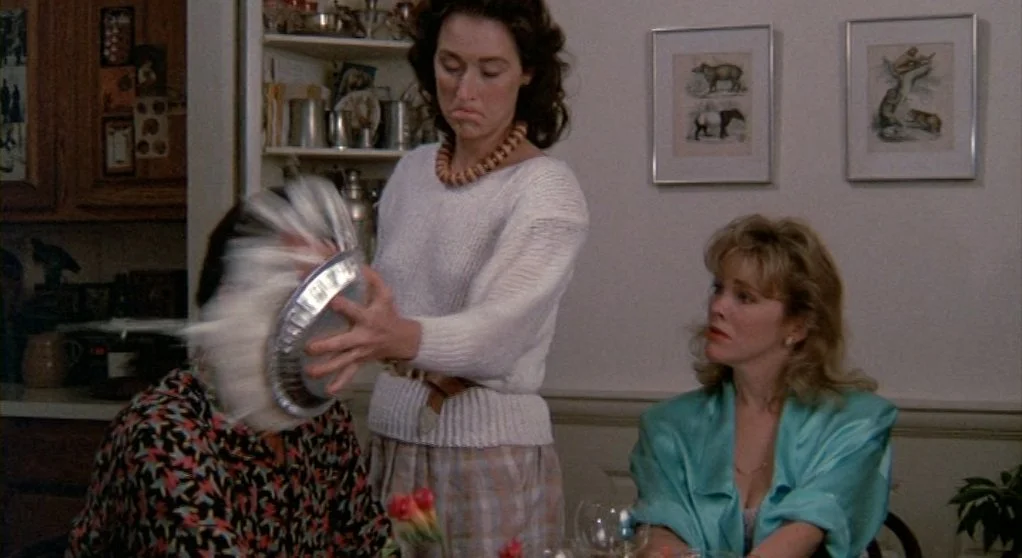
He deserved it. (Heartburn, 1986)
As Ruefle elaborates, “the moment of admiration is the experience of something unfiltered, vital and fresh” not unlike the sense of potential, amazement, and naivete with which one might enter a new romance. As the initial illusions fade and the realities make themselves known, the clarity afforded by disappointment becomes an opportunity to take agency and make decisions in marked contrast with the uncontrolled fall at the onset. Or as Ruefle puts it, a moment of “dignification” where the writer—or for our purposes, the lover—can take back control of the story.
For writer and director Nora Ephron, dignifying the consequences of her origins meant using it as fodder for her literary work. From the Esquire magazine essays that pulled from her daily life to the dynamic romantic comedy heroines she wrote to deliver her personal philosophies on screen like Meg Ryan-shaped ventriloquist puppets, Ephron was an unapologetic miner of her own lived experience; a self-described “cannibal” who took her screenwriter mother’s adage to heart that “everything is copy.”
The practice of taking inspiration from one’s own life to create art is hardly unique to Ephron, but what is notable is the deliberate way she used it to take control of the events and moments she found most painful, skillfully wielding the ugliest details like a weapon, turning the heartbreak and embarrassment into a source of strength and creative triumph. As she explained in “Everything Is Copy,” the aptly titled 2016 HBO documentary directed by Ephron’s eldest son, Jacob Bernstein: “when you slip on a banana peel, people laugh at you. But when you tell people that you slipped on a banana peel, the laugh is yours. So you become the hero, rather than the joke.”
Owning the laugh was very much the driving force behind her 1983 novel, Heartburn, and the subsequent 1986 film adaptation directed by Mike Nichols. The thinly-to-the-point-of-transparently veiled comedy fictionalized Ephron’s marriage and divorce from Washington Post superstar reporter Carl Bernstein, turning the sordid tale of Bernstein’s much-publicized affair with the wife of the British ambassador while Ephron was 7-months pregnant with their second child into…a breezy hilarious tale about a food writer named Rachel Samstat whose Washington Post superstar reporter husband Mark Feldman cheats on her with the wife of the British undersecretary while she is 7-months pregnant with their second child.
The novel was an immediate success, rocketing up the bestseller lists as Ephron charmed her way through the talk show circuit laughing with delight as late-night hosts like David Letterman held the novel aloft in the air and exclaimed with horror, “Cheating on your 7-month pregnant wife? This is ugly!” Her exaggerated shrugs and smirks almost seeming to say in response, “you said it, buddy, I didn’t!”
But the truth is she did, in fact, say it. Loudly. Publicly. Hilariously. As Rachel notes in the novel (echoing Ephron’s real-life feelings) “if I tell the story, I control the version. …if I tell the story, I can make you laugh, and I would rather have you laugh at me than feel sorry for me.” In many ways, Heartburn is more a novel about the power of speaking up for oneself than it is about marriage or divorce. As the novel opens, Ephron’s fictional stand-in, Rachel Samstat, confesses, “The first day I did not think it was funny. I didn’t think it was funny the third day either, but I managed to make a little joke about it.”
In the opening scene, she has just learned about Mark’s infidelity and returned to her father’s house to nurse her broken heart. And yet even in those initial sentences, the reader meets a character who acts with intention. She may not be able to stop crying, but she has managed to get on a plane with her toddler, fly to NY, cook herself a pot of comforting mashed potatoes, and (most importantly) “make a little joke about it.”
As director Mike Nichols remembered in her son’s documentary, this sense of action despite despair reflected her real-life trajectory. Upon learning about Bernstein’s affair, Ephron packed up her toddler, left the marital home in DC, and moved to a friend’s house where she “cried for six months,” before finally returning to her typewriter to “[write] it funny.” A brave and decisive act that ultimately changed the entire trajectory of her life.
But as is often the case when women refuse to stay silent, it’s important to note that Ephron’s choice to fight back publicly was met with nearly as much scorn as celebration, particularly from puritanical male critics who declared the fact that she, a mother, wrote a novel about the story a somehow worse transgression than Bernstein’s tawdry affair. As Rachel Syme pointed out in a 2022 New Yorker article, a 1985 article in Vanity Fair written by Tristan Vox (a pseudonym for Leon Wieseltier) declared: "Here is Carl Bernstein and adultery; there is Nora Ephron and child abuse. It is no contest."
The need to “protect the children” became Bernstein’s own primary battle cry in the ensuing lengthy divorce (never mind that it was in fact his flagrantly indiscreet affair which led to the dissolution of the marriage and broke up the family home). Though Ephron did ultimately achieve massive success through her actions, it was not without struggle. This real-life clash is clearly showcased in the on-screen version of Heartburn, the screenplay for which became one of the most contentious parts of the pair’s divorce. As part of the settlement, it was stipulated that the husband’s character (played by Jack Nicholson, alongside Meryl Streep’s Rachel) must always be shown as a loving and caring father.
Returning to the film with this in mind, Bernstein’s attempt to wrest back control of the narrative is glaringly obvious, producing a film that feels softer and far less toothy than the bitingly witty novel. The film is more romantic, spending significantly more time on the initial love story and painting the Bernstein/Mark character as both a charming lover and friend. In the novel (and real life), there were multiple affairs, and the husband character had at one point even proposed an arrangement that would allow him to continue to keep his mistress while maintaining the marriage for the children. The film was ultimately stripped of so many of the tawdrier details, that were it not for Jack Nicholson’s skill at exuding unapologetic cad with every inflection of his voice, it would likely not have worked.
The most significant changes, however, relate to the children. Though in both real life and the novel the pair had two sons; the movie version swaps the boys for two daughters (the oldest played by Streep’s real-life daughter Mamie Gummer), an attempt to create further distance between the real and fictional. And as required by the divorce settlement (and to the detriment of the film), each scene that shows Mark as a bad husband is alternated with a scene of him as a performatively good father: if he is rude and dismissive to Rachel, he is next shown playing on the floor with the toddler; before heading out the door to meet his mistress, he sings the child a song and kisses her goodbye. In the most absurd scene of all, Streep’s Rachel sits at her vanity table talking to her best friend about how awful the affair has made her feel while a framed photograph of Mark holding the baby remains awkwardly and prominently in full focus, reminding us once again that this terrible husband is a Very! Good! Dad!
Notably, it is at the very end with the roll of credits that we see another effort to protect the not-so-innocent: white on black words that pause momentarily on screen, assuring viewers that “any similarities to actual persons or events is unintentional.” The type of boring legalese rarely registered due to its ubiquity, seeming suddenly egregious, even offensive, for a story that was very much told with intention.
And yet, history suggests that Ephron anticipated—and likely welcomed—the opposition to her dramatic act. In 2023, 40 years after the release of Ephron’s novel, Maggie Smith (the poet, not the dame) wrote about her divorce from her own philandering husband, detailing the way her marriage broke down as she began to achieve increasing amounts of professional success. In a poem titled “After the Divorce, I Think of Something My Daughter Said about Mars,” Smith writes:
Once you go, you can never come back.
If you returned to Earth,
the gravity would turn your bones
to noodles. I mean your skeleton
would sort of melt. So if you go,
you have to stay gone.
The sense of finality in those words “if you go, / you have to stay gone” points to another significant aspect to the concept of literary agency after heartbreak beyond simply revenge or controlling the narrative (one which Ephron understood deeply): the burning of the bridge.
This understanding is evidenced in a surprising detail shared by legendary gossip columnist Liz Smith in the HBO documentary: upon finally deciding to leave her husband, Ephron called Smith and gave her the story, encouraging her to print it in Smith’s nationally syndicated column. A bold act that Smith understood to be a form of self-protection that would solidify her decision to leave and prevent her from ever going back. As Rachel Samstat’s character says in the novel, “To write it down was to give it permanence, to admit that something real had happened.”
A declarative act in many ways reminiscent of the work of Ephron’s rom-com predecessor, Jane Austen, who also understood the finality of the written word. Much the same way Captain Wentworth’s love letter in Persuasion permanently bound him into a marriage contract, so did Ephron’s written word release her from her own. Essentially, by encouraging Smith to print that she was divorcing Bernstein, Ephron codified her decision in a permanent and concrete way, organizing her disappointment and using the power of the printed word to exert control over the irrational pull of love.
Ever the brilliant storyteller, Ephron turned this defining moment into one of the final and most legendary scenes of both the novel and movie. Rachel (having earlier in the day learned that Mark had continued his affair despite promises and pleas for reconciliation) takes the step she knows she will never be able to take back: smashing a whipped cream-covered key lime pie in his face in the middle of a dinner party hosted by the Liz Smith stand-in, the notorious town gossip. As she silently thinks to herself just before doing so, “If I throw this pie at him, he will never love me. But he doesn’t love me anyway. So I can throw the pie if I want to.”
The choice of using a pie for this moment is brilliant on multiple levels. Pieing, also known as the “pie in the face” gag, has been a staple of slapstick comedy since the vaudeville and silent film eras. The act, which is meant to humiliate without causing physical harm, is objectively funny, essentially the ultimate visual and physical manifestation of the concept of comedy as a weapon. Having grown up with parents involved in theater and the early days of Hollywood, the significance of this act would have been part of Ephron’s childhood education.
For the character Rachel, a cookbook author and writer, to use her art (food) as a weapon to publicly humiliate the husband who had betrayed her mirrored Ephron’s use of her art (words) to do the same to Bernstein. And to do so at the table of the one woman who would make sure everybody in society heard about it, assured that there would not—and could never—be any turning back.
The film version of Heartburn has since gained cult-like admiration, but it was not as much of a success as the novel. While a failure at the box office, its production proved to be one of the most pivotal moments for Ephron’s career, catapulting her from an East Coast magazine writer to legendary Hollywood screenwriter and director known for iconic romantic comedies like When Harry Met Sally, Sleepless in Seattle, and You’ve Got Mail.
During production, director Mike Nichols commissioned the singer-songwriter Carly Simon to compose a theme for the film. Simon, who had recently experienced her own bad breakup from fellow musician James Taylor, wrote and recorded “Coming Around Again,” a bittersweet song about disillusion and dissolution that somehow maintains a sense of hope even in the face of bad love.
With a bridge that declares “don’t mind if I fall apart / there’s more room in a broken heart” and a repeating refrain of “I still believe in love,” it is a fitting soundtrack to both versions of Ephron’s story, written and lived. Afterall, had it not been for the space created by her broken heart and broken marriage, we may never have gotten to experience some of the greatest love stories of all time.