
It takes me a few minutes to understand why I feel so uneasy in front of Josiah McElheny’s “From the Library of Atmospheres II.” a sculptural glass assemblage at James Cohan’s 48 Walker Street gallery. It is, I finally realize, because though I am fully aware that I am peering into a world of glass and mirrors, my reflection is missing. Like a child or a puppy encountering an unfamiliar object, I keep stepping closer and further away from the work, tilting my body from side to side, as if convinced that by finding the correct approach I will solve the puzzle presented.
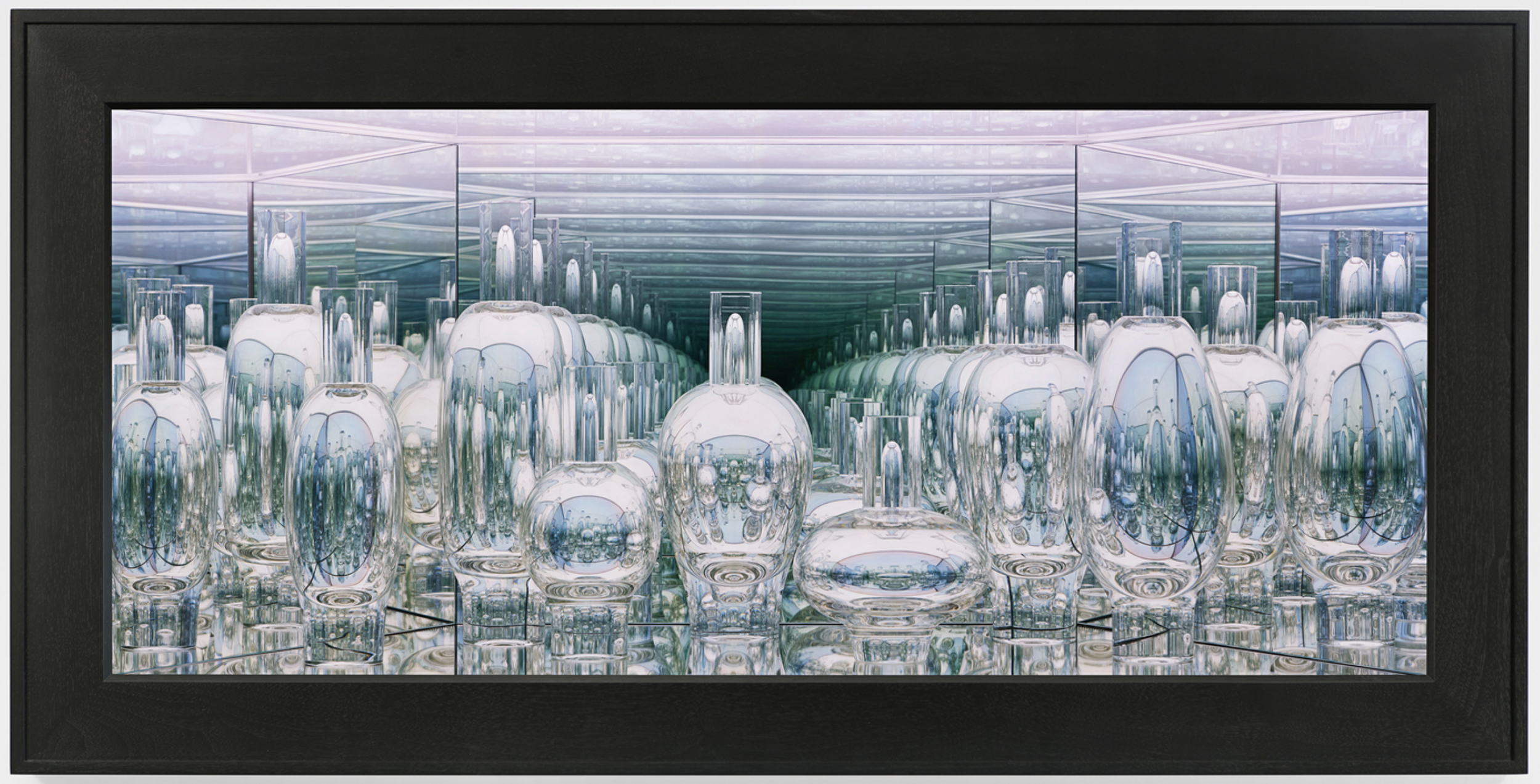
Josiah McElheny (b. 1966) “From the Library of Atmospheres II” 2025
My efforts are in vain. I feel like a vampire. A ghost in the gallery.
McElheny achieves this haunting effect with a simple trick; the clear glass window I am looking through is in fact a two-way mirror like the kind in tv detective show interrogation rooms (perhaps also real ones; I’ve not had the pleasure). Observing this work, I’m intensely hyperaware of my presence in relationship to the art. I am removed, on the outside looking into an enclosed world where McElheny’s carefully arranged hand-blown bottles exist in their own mirrored isolation. It is also an interrogation room of sorts; the bottles in ongoing conversation and observation with themselves—a self-interrogation, An, as McElheny describes, “infinite narcissism.”
“From the Library of Atmospheres II,” is inspired by The Library of Babel, a mystifying story written in 1941 by Argentinian writer Jorge Luis Borges that imagines the universe in the form of a vast library containing all possible permutations of a 410-page book made from a set number of characters. In McElheny’s conception, the library is one containing “atmospheres” depicted through blown bulbous bottles and objects understood to contain air, gas, oxygen, hydrogen—substances that, like knowledge, can expand and fill regardless of container. Forever existing in a state of infinite possibility, “as mysterious as knowledge itself.”
And yet it is a still expansion, or rather an expansion of stillness. Repetition propelled forward and yet…not. According to the artist, “Maybe the qualities of the mixtures of gases could be ‘read,’ if you will. Maybe they’re not only a set of measurements but actually there are whole novels to be understood or experienced in the inhalation of an atmosphere.”
The feeling of surprise is magnified by the way the work is displayed. It is hidden away from the other exhibitions in the gallery, tucked away alone in its own tiny viewing room which I would have easily missed had I not been beckoned through by gallery assistant eating her lunchtime cob salad. Upon initial approach, the work appears to be a framed 2D still life hung flush on the wall—perhaps a photograph or a photorealistic tromp l’oeil painting. But as one approaches, the depths of its reality are revealed. We are looking at a diorama inserted into the wall—in the catalog, this is described as an “architectural intervention”—suggesting a hidden universe existing in a liminal space between planes, like the childhood stories about The Borrowers who live entire secret lives parallel to our own.
Only about a foot and a half deep, the placement of mirrors extends the visual space far beyond its physical dimensions. Inside is the collection of curvaceous glass bottles blown by McElheny—a master glass artist whose medium literally breathes creations to life. Alternatively tall and squat, the bottles vary in size and shape, but are arranged in a balanced way. The reflective glass appears cold, silver, metallic, with atmospheric hints of turquoise and pale green, but is contrasted by the frame made of black mahogany wood—an edge of warmth that serves as the threshold between the liveness of our world and the stillness of this curious alternate space.
In the absence of my reflection, this contrast between my own world and the mirrored one the art inhabits, is intensified. My relationship to the art as spectator made clear. My own narcissism curtailed.