
The sunlight streaming through the sepia-red corton steel bars of Edra Soto’s GRAFT (2024) installation at Doris C. Freedman Plaza in Central Park decorates the asphalt terrace with geometric patterns of light and shade, summoning a flicker of memories.
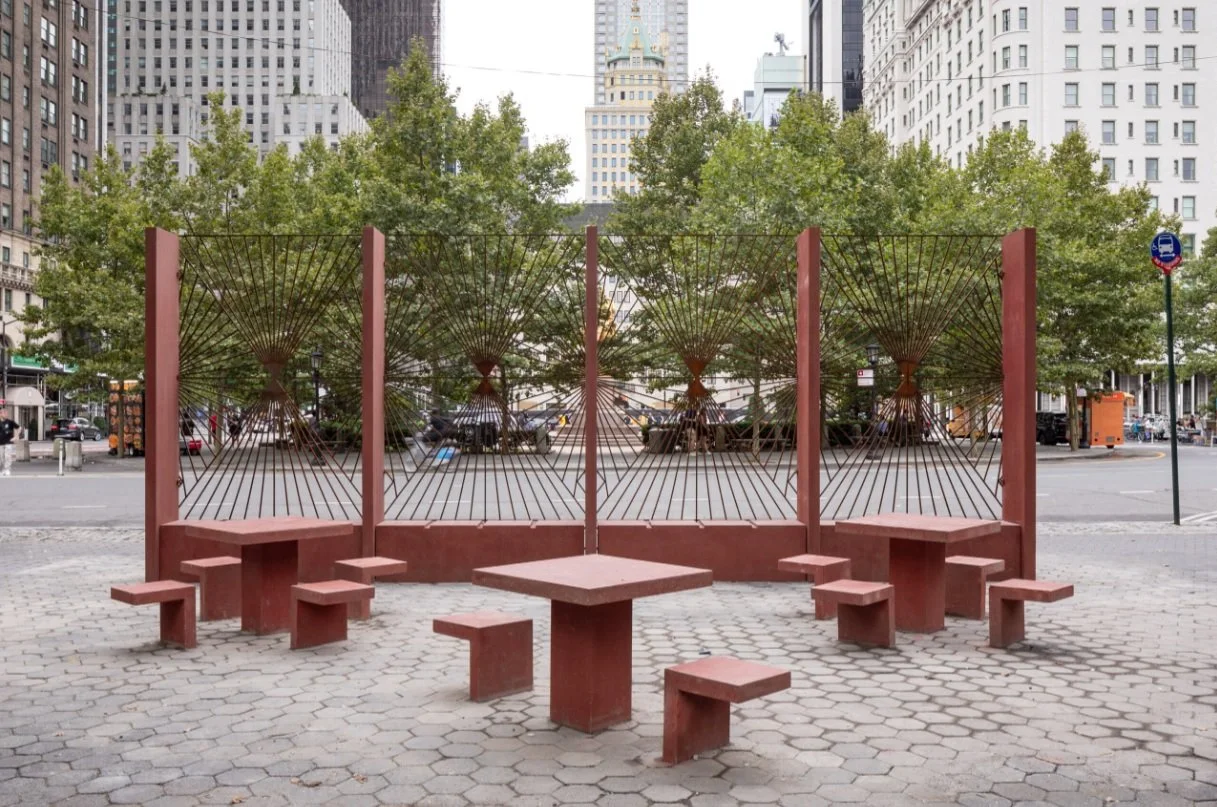
Edra Soto, Graft, 2024 Photo: Nicholas Knight, courtesy of Public Art Fund, NY. Presented by Public Art Fund at Doris C. Freedman Plaza, New York City, Sep 5, 2024 – Aug 24, 2025.
Morning sun rising through the window grates of my cousin’s teenage bedroom while someone brews coffee down the hall. The coolness of the damp golden sand shielded by palm frond silhouettes. Fading light sinking down textured terracotta walls in my aunt’s Ocean Park courtyard.
Though the work itself also feels familiar, reminiscent of so many homes and places in my family’s native Puerto Rico, there is something specifically about the way Soto’s art interacts with the space it inhabits that strikes a particularly resonant chord.
It’s September when I visit. The weather and the calendar both say it’s still summer, but spiritually the city has welcomed Fall and its fresh-start feeling of newness. Department store vitrines and restaurant menus are flaunting their autumnal best, and galleries throughout the city are accounting their newest exhibitions. Soto’s work is among these new pieces of art, but unlike those constrained by gallery hours or museum admission, GRAFT (2024) is a public work installed in one of the most-trafficked corners of the city, freely available 24/7 to anyone who passes. There are no lines or tickets. All are welcome and invited, the only ask is that you notice.
Born and raised in Puerto Rico, the multidisciplinary visual artist Edra Soto began her career as a painter while studying at the Escuela de Artes Plásticas y Diseño in San Juan. Her early work leaned toward Caribbean-inspired surrealism and magical realism, themes which appealed broadly in the island’s tourist-centric commercial art market. Represented by a popular local San Juan gallery, her work sold well, but as she expressed in a 2021 Foundwork interview, she soon felt like she had “hit a wall” and grew disenchanted with a way of working that felt limited and transactional. Seeking new inspiration and ways of working that allowed her to be in community, Soto left Puerto Rico in 1998 to pursue an MFA at The School of the Art Institute Chicago, hoping graduate school and a new environment would reinvigorate her artistic direction. In Chicago, Soto grew in community with like-minded students, honed and developed her artistic practice, and met and fell in love with fellow artist Dan Sullivan, who would eventually become her husband and frequent collaborator. Her life and practice deepened and took root, and it wasn’t long before her temporary sojourn turned permanent.
In interviews, Soto has explained that she conceived GRAFT in 2012 to examine the complexities of her feelings about her own migration and the realities of making a life within the boundaries of the nation actively colonizing her native home.
The name of the project comes from the surgical procedure that removes and transfers living tissue from one part of a body to another. If all goes well and a graft takes as intended, the living tissue roots a new blood supply, growing into and with the surrounding cells, a complex and remarkable procedure that brings forth healing and continued life. Yet, in even the most successful of transplants, there can be scars, different colorations, or subtle disfigurements; demarcations of varying levels of visibility that serve to physically define a line between the then and the now. The parallels to human migration are evident, and particularly visceral to anyone who has ever uprooted their life to make a new home away from home.
Mining her memories of the island and her childhood, Soto looked for ways to incorporate elements that felt familiar and distinctly Puerto Rican while bearing in mind the legacies of colonialism and violence that dominate much of the island’s popular visual language. Her work, which she refers to as “architectural interventions,” deliberately eschews Spanish colonial aesthetics and subverts the stereotypical tourist-centric tropical motifs often associated with Caribbean art, a fact about which she is unequivocally clear. In multiple artist talks and interviews, she points out the ways symbols of colonial rule—like the distinctive stone garritas or sentry boxes, once used by Spanish soldiers to police and surveil—have since been adopted as charming representations of the island, sold in souvenir shops, and even used in the official logo of the Puerto Rico Tourism Board. Instead of tropical beach scenes and pastel-colored renditions of military and Spanish architecture, Soto’s work highlights elements like the veves and other geographic symbols of the Yoruba who were forcibly brought to the island and whose cultural legacy is often ignored and pushed aside in favor of that of the colonizing forces.
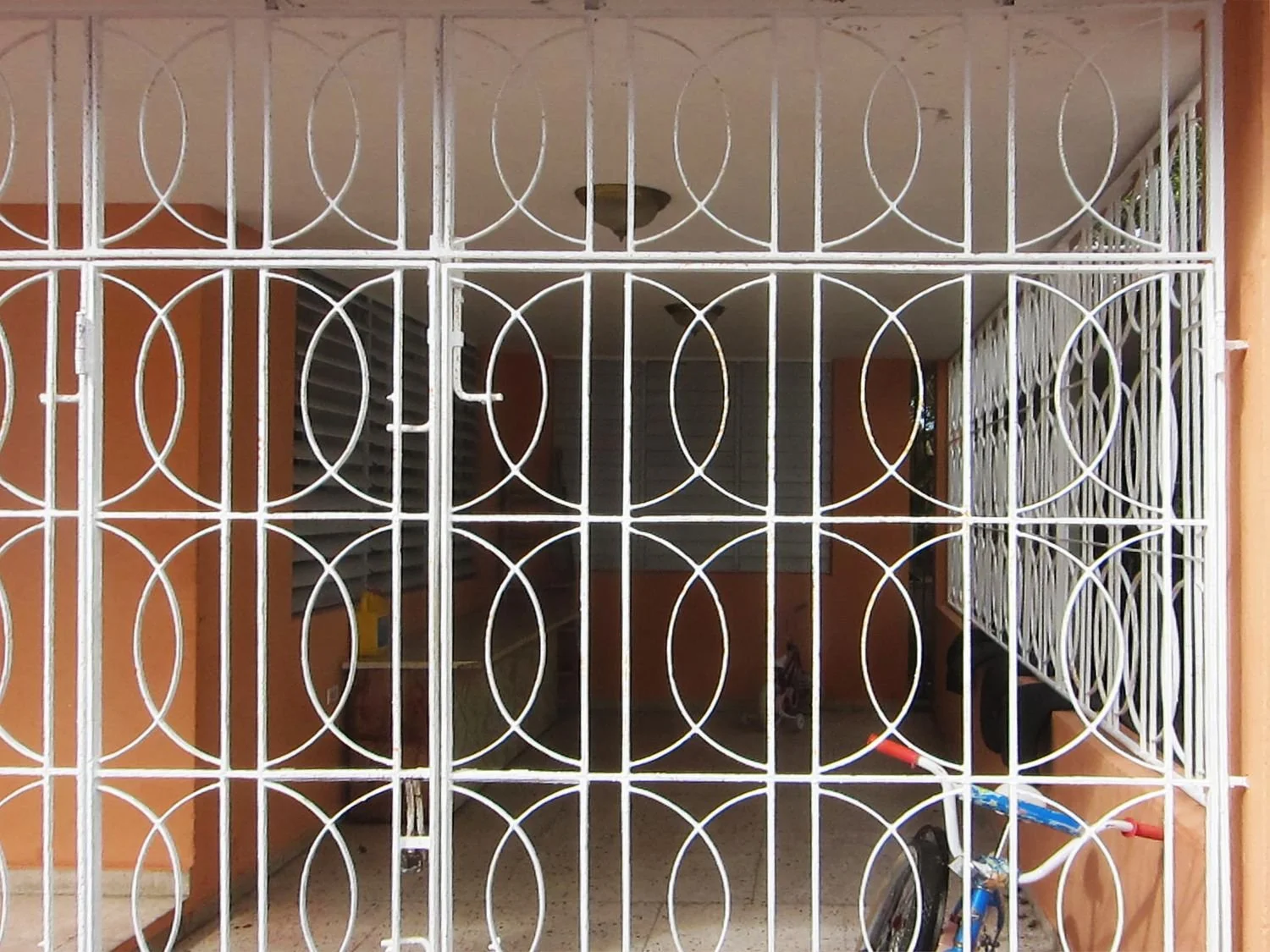
Rejas on a Puerto Rican home
Soto pairs these elements with the architectural features and designs of her Cupey hometown, homegrown features that formed in response to climate and cultural needs. While her pieces vary in style, colors, and structural concepts, each iteration of GRAFT incorporates translations of Puerto Rican vernacular architectural features like the geometric wrought iron rejas that adorn and protect houses in the island’s working-class neighborhoods, the perforated quiebrasoles that temper the heat of the sun while allowing for cross breezes and natural ventilation, as well as oft-ignored cornerstones of Puerto Rican daily life like bus shelters and playground domino tables.
For a 2022 exhibition at The Whitney about the aftermath of Hurricane Maria, Soto incorporated viewfinders loaded with personal photographs taken before, during, and after the hurricane struck the island. To see the photos, visitors to the museum had to step up close to a wall of decorative gates and peer through the perforations, an invitation to voyeurism that seems to question and complicate a dedicated “American” art museum featuring works by and about a place subject to its colonial rule. In a December 2024 panel hosted by Forecast Public Art, Soto described the experience of working with The Whitney and their Puerto Rican curator Marcela Guerrero as supportive and enjoyable, but also noted that she always finds ways to assure her message is not lost regardless of the prestige or history of the venue. Though aesthetically pleasing and welcoming to guests from all walks of life, Soto makes it clear that the work is not meant to be merely looked at.
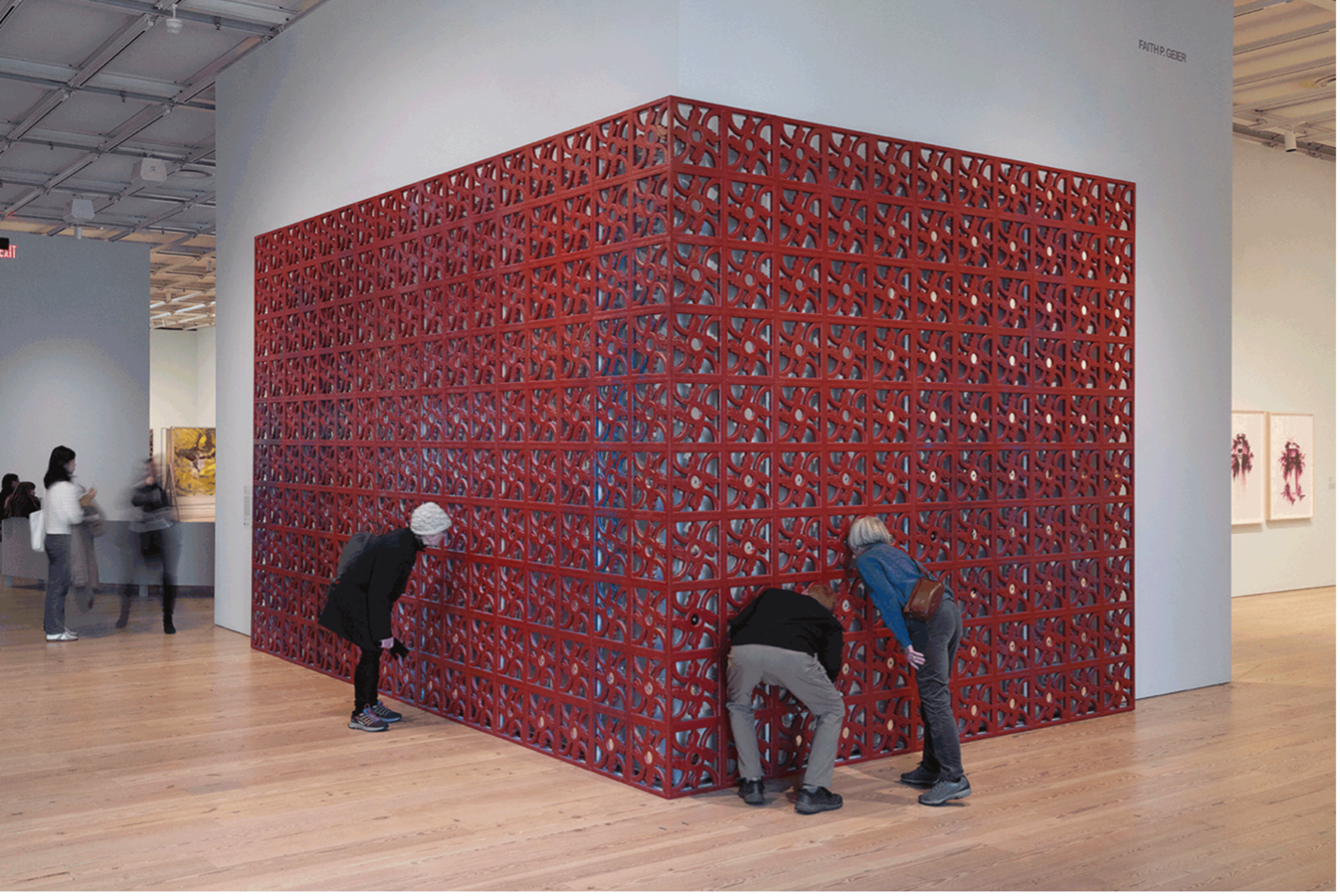
Edra Soto, GRAFT 2022, at the Whitney Museum
In his book The Poetics of Space, French philosopher Gaston Bachelard referred to the concept of the “psychic state,” essentially a mental collection of ideas, feelings, and associations that expand upon the realities of a physical place like a house. As Bachelard wrote “even when reproduced as it appears from the outside, [the house] bespeaks of intimacy.” Clusters of tables and chairs are not uncommon in New York—similar seating areas can be found in numerous parks and public courtyards throughout the city—but what I believe sets GRAFT (2024) apart from other gathering areas is the presence of the house façade, which draws upon the tenets of psychic state to help all who pass through its margins feel temporarily at home.
Though I was born in New York and raised in New Jersey, I grew up regularly visiting the island to spend time with our large extended family, sometimes as often as four or five times a year. Our house may have been physically miles away from San Juan, but my parents did their best to keep the island as an extension of our own home, not unlike the way our family seemed to constantly flow between each other’s homes and spaces. While my family had the financial privilege that allowed for the frequency of these visits, we also enjoyed the specific privilege that sets Puerto Rican diaspora communities apart from all others in the US: natural born citizenship that allows unrestricted travel and migration between Puerto Rico and the mainland. But this also comes with an increased awareness of the political, economic, and environmental challenges of life on the island. There are currently twice the amount of Puerto Ricans living in the mainland than on the island; a fact which means that to be Puerto Rican is to be uniquely aware that we are divided by both geography and circumstance.
During each of my visits to GRAFT, I’m repeatedly struck by the way Soto’s use of these elements allows her work to tap into what feels like a distinctly Puerto Rican understanding of home, recreating elements of a world that is simultaneously public and private, interior and exterior, present and distant. This flexibly boundaried welcome feels distinctly Puerto Rican to me. The houses and apartments where my family on the island lived, exemplified a kind of porosity completely unlike our strictly delimited New Jersey home.
In Puerto Rico, breezes, sunlight, aromas, music, and conversation seemed to be in constant flow through the open bars and slats of decorative gates, louvered doors, and perforated cinder blocks. (It must be said that this is not without its drawbacks—open doors also meant mosquitos, corrosive salt air, and the inability to hide from nosy neighbors, just to name a few.) This sense of flexible space is not limited to the physical, but indeed emblematic of the way so many Puerto Ricans live their lives in and within community.
In GRAFT (2024), this duality is expressed through the pairing of a large decorative steel façade set before a communal area featuring three sets of terracotta tables and chairs. Though all the pieces of the work exist in open air without doors or barriers of any kind, the combination of façade and furniture creates a kind of open-air house that welcomes all to enter, sit, and share in community with others, actively becoming a part of the art.
In essence, Soto’s work exists as an ongoing co-creation with the environment in which it is displayed, and that includes the people who inhabit that space and without whom the work would not be complete. This welcoming hospitality of Soto’s work makes sense for an artist—and a community—forever wrestling with a deep understanding of what it feels like to not always feel at home.
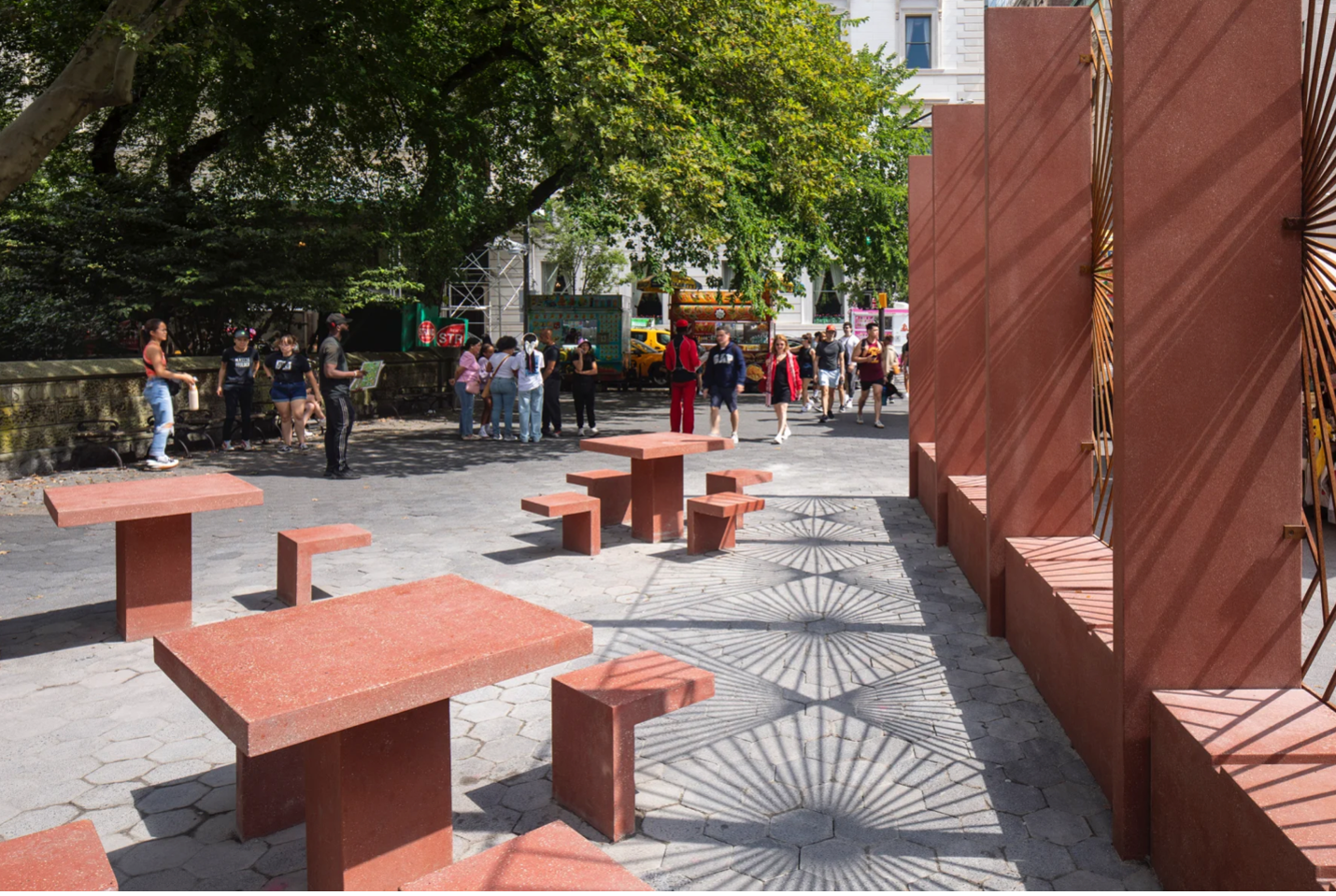
Edra Soto, GRAFT, 2024, New York, NY