
Created by the poet, curator, and art critic, John Yau (b. 1950), a “Pollock” is a playful and inventive poetic form that pays homage to the work of the abstract expressionist painter Jackson Pollock (1912 - 1956).
The “rules” are simple and reminiscent of Pollock’s own methods. Yau first used the form in a poem called “830 Fireplace Road: Variations on a sentence by Jackson Pollock.”
A Pollock is a 14-line poem that must begin with a line or quotation said by the artist. This initial line serves as your poetic painter’s palette, so to speak, from which you will then create the subsequent thirteen lines.
Each of the following 13 lines must consist of only words or letters from the first ones. The words can be repeated, rearranged or used in any order you’d like. The use of rhyme, meter or visual form is also up to you.
(I personally think this is an ideal form for playing around with concrete styles of poems, splattering and dripping the words around the poetic canvas like the artist did with his paint.)
My favorite rule for writing a Pollock is that rule-breaking is not only permitted, but encouraged. If a bit of dust, hair, or cigarette butt gets caught in the lines, so be it.
Let it be.
What is interesting about this poetic form or prompt is that it presents an interesting alternative to tradition exphrastic writing. Here, instead of creative writing that is inspired by a work of art, the writing flows from the words and methods of an artists. In doing so, it is as if the poet, with their poem, is affirming the artistry and merit of the artist’s words and methods themselves, apart and independent of the work.
Unlike some of his more verbose contemporaries, Pollock eschewed most press interviews and left behind limited written statements. (It is believed that even the titles of his works were not his own creations, but rather ones suggested by his friend and champion, the critic Clement Greenberg.) But in July 1956, just a few weeks before his death, he agreed to a rare interview with the writer Selden Rodman, which was later collected in the book “Conversations with Artists” (out of print, but available online in various used and collectible formats.)
There, Pollock told Rodman:
“Something in me knows where I’m going, and — well, painting is a state of being. … Painting is self-discovery. Every good artist paints what he is.”
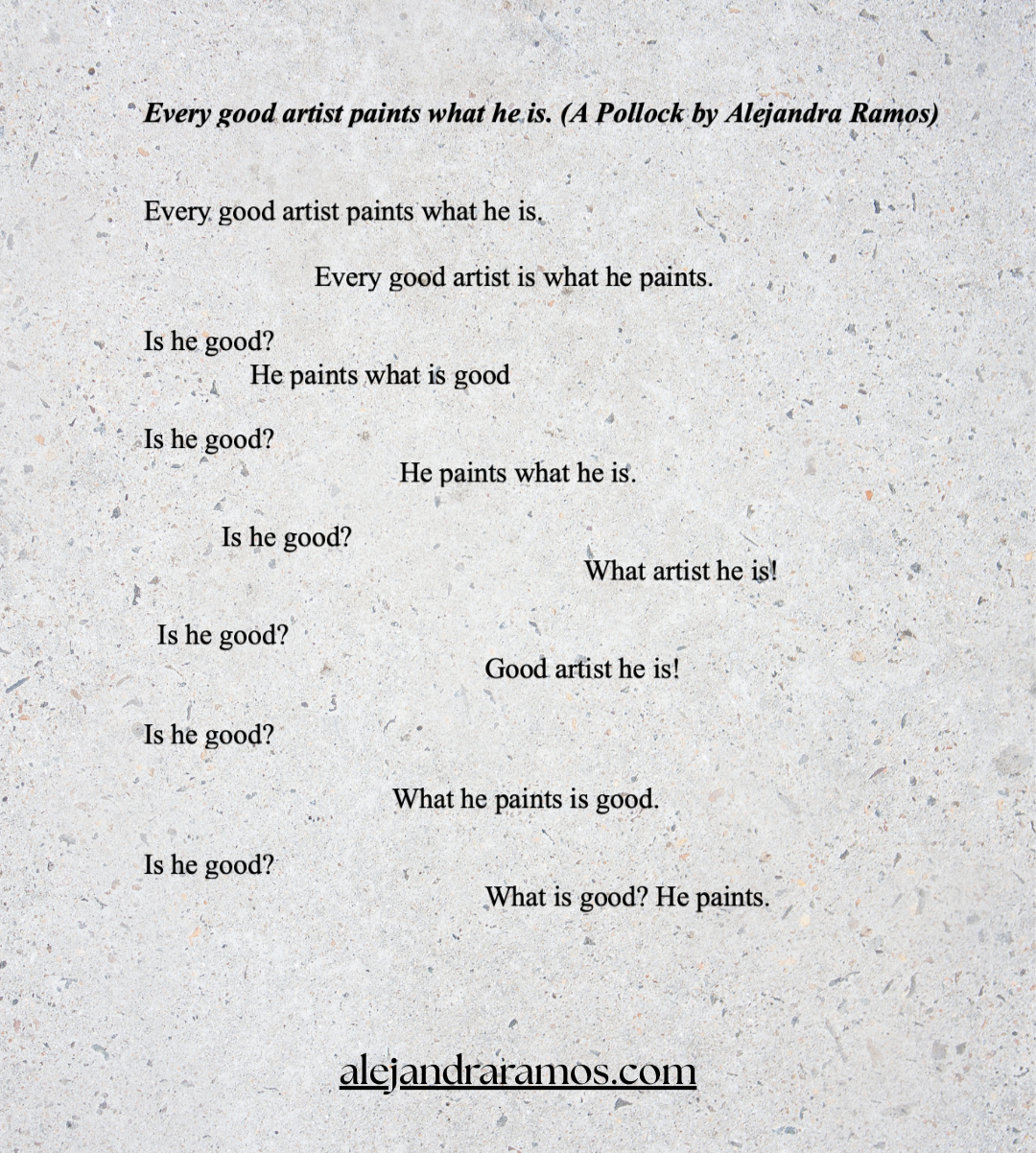
Here is a Pollock poem I wrote based on this interview:
Every good artist paints what he is. (A Pollock by Alejandra Ramos)
Every good artist paints what he is.
Every good artist is what he paints.
Is he good?
He paints what is good
Is he good?
He paints what he is.
Is he good?
What artist he is!
Is he good?
Good artist he is!
Is he good?
What he paints is good.
Is he good?
What is good? He paints.