
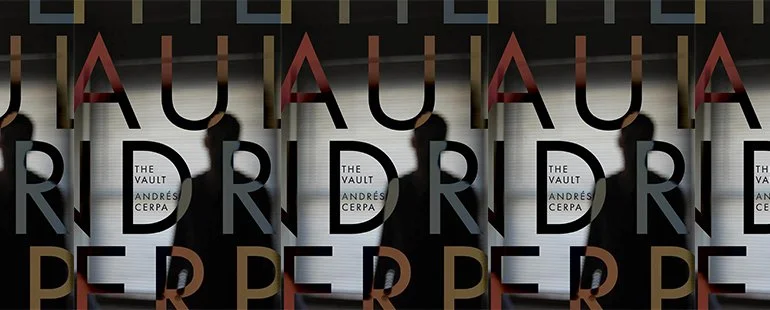
A Preface: These journal entries are excerpts from a reading journal I kept for one of my Columbia writing classes while filming on location last fall. Read the first of these entries here. They are addressed to my professor for that course, Lars Horn.
Dear Lars,
I remember you telling me Cerpa is Puerto Rican, and I was particularly looking forward to spending time with his work here in this dearth of Latino-ness. Even when there is nothing specifically “Latin” or “Puerto Rican” in the work, I always have this underlying sense that somewhere along the line there must be a dash of commonality. Even something as tiny as a type of food, a phrase, a tradition, a habit. Something in the recipe of this person that mirrors the recipe of my person that eventually sneaks into the work itself like a form of common terroir. Not that this equals knowing.
One of our filming days here is set aside as a “Promo Day,” where we do things like photoshoots for the show poster and ads, video interviews with the publicity team, etc. (This may feel like a digression, but I promise it’s not.) One question I’m asked over and over is “How does food build bridges between cultures?” I hate this question because it oversimplifies and makes assumptions (that bridges don’t already exist, that bridges are even necessary, it even assumes distance/space), but I usually say that it’s not that it builds anything, but rather that it reveals what is already there for those who are willing to look—whether that be existing connections or existing spaces. It provides a framework for encounter. An entry point of knowing or of even allowing for not-knowing. I think love and grief also work in the same way. The universality of human experience that allows those who are willing, to witness even if it’s just to witness the loneliness and unknowability of the experience.
The image I keep thinking about in Cerpa’s work is “the father disintegrating in a purple chair.” It’s an image both real and surreal; solid and ghostly. It could mean disintegration as in the ways our human bodies break down as we age, but there is also a sense of visual dissolving. A ghost disappearing. A memory fading. The grief contrasted with new love is stunning. The way love or relationships or even friendships start in this kind of airy ethereal way but grow stronger. There is a parallel vulnerability to the way that in one case one person is slipping away while another is coming clearer into focus.
This also makes me think of the cover image of Natalie Diaz’s book, Postcolonial Love Poem. The way she has spoken about purposely moving during the photo in order to capture an image that shows what cannot be captured. A pushing back against the “American” need to capture and commodify, itself captured and (as it’s a book cover) commodified.
Thinking back to the letter-like format of the foreword in Aisha Sabatini Sloan’s Borealis, there is a similar sense of address in Cerpa’s poetry. A sense of “you” that seems to move between the father, the reader, the lover (Julia). Some of the poems are written in a letter-like way—with salutations “Dear Mom” “Dear Dad,” though they never seem to complete. There is never a sign-off at the end. The book opens with the words “Join Me” which instantly gives the proceeding words a sense of invitation and invocation. We are asked to witness. Asked to be a part of this excavation.
There is a stunning intimacy to it, and I also can’t help but feel like it serves as a disclaimer of sorts—the idea that there is a search in progress, feelings in progress. We are being allowed into the process of discovery.
This also makes me think of another Diaz’s anecdote about learning the Mojave language and being told that she “don’t know nothing” and that there is so far left to go. Everything is essentially always in process. That these words are in communication with the dead suggests continuation even beyond the physical. In life and in death, there is no end.