
The marquee image for the 2020 MoMA PS1 exhibition “Marking Time: Art in the Age of Mass Incarceration” curated by Dr. Nicole Fleetwood, is from a mixed-media portrait titled “Locked in a Dark Calm,” by the artist Tameca Cole.
Though in digital reproduction it appears substantial, it is a relatively small piece—only about the size of a standard sheet of printer paper. In the work, the fragmented figure of a Black woman looks out from the center of a swirling charcoal and graphite cloud which extends to the edges of the page.
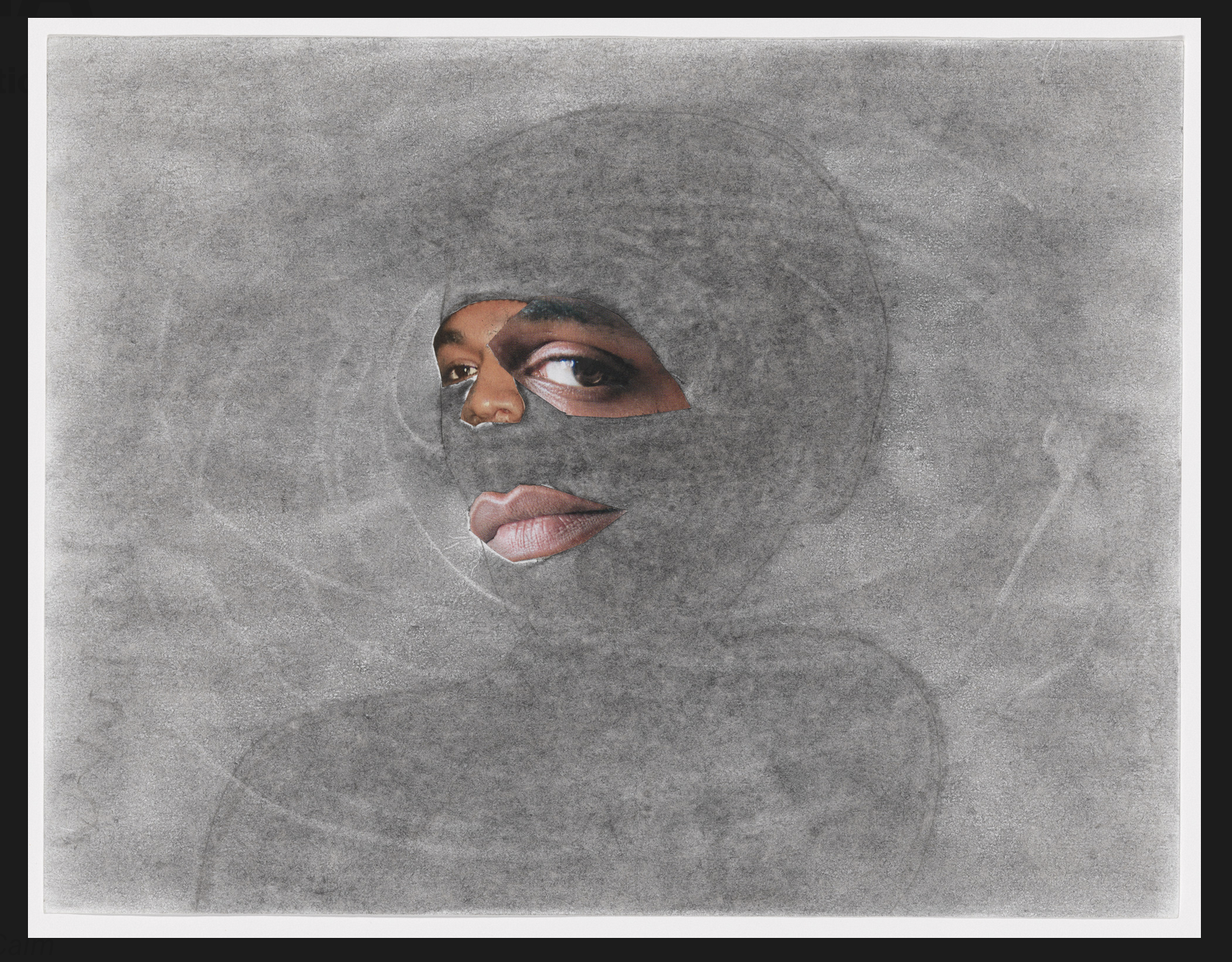
The head and torso of the woman appear in a gray shadow, mostly obscured by a charcoal maelstrom that swirls in haphazard loops around and through the central figure, mummifying the silhouette. Collaged over the whorls in the center of the page are the parts of a face cut from magazines: a pair of full unpainted lips, a nose, and a pair of dark brown eyes—one stoically gazing off-center into the distance. The other, significantly larger, and side-eyeing directly out from the canvas as if keeping a skeptical, watchful eye on the viewer.
Tameca Cole made the piece in 2016, while incarcerated at Julia Tutwiler Women’s Prison in Wetumpka, AL, where she served 26 years from age 21 to 47. To Cole, the piece served as an outlet for the anger and rage she felt at constant mistreatment from prison staff, and “symbolized the experience of having to process anger inside of a controlled and contained environment.” Knowing she was in an environment where she couldn’t express anger without retribution, she sought other ways to channel the feelings.
As Cole told NPR in a 2020 interview coinciding with the MoMA show, that day she felt “Angry enough to mess up everything I had worked hard for,” but the act of creating served as a constructive outlet for her to release the rage without harming herself, others, or incurring penalties or punishment. Within this context, the disparity between the eyes seems to indicate the condition of a place where one is always watched and must always watch. The prominent side-eye a representation of repressed feeling and unspoken words trapped within a charcoal cloud state of imposed calm.
The disproportionately sized facial features in Cole’s piece bring to mind the work of Romare Bearden, who often used elements like oversized hands and eyes to control focus and emphasize specific elements of the story. For Bearden, fractured images and abrupt changes in size spoke to the fragmentation of the Black experience within a societal structure that consistently imposes delays, distraction, separation and interruption, themes which Fleetwood also identifies as being part of the expansive harm of a carceral system that not only removes people from society, but which also, like collage pieces taken from disparate sources, makes it all-but impossible for them to ever fully seamlessly reintegrate.
When Cole speaks of her art, she acknowledges the lasting influence of her time in incarceration. She speaks of the PTSD she deals with after her protracted sentence, and what she describes as an “ongoing experience of never being able to fully shed the skin” of her involvement with the justice system, as well as her desire to use her art to raise awareness of mass incarceration, injustice, social economic disparities, and her belief that we all need to consistently work to be better humans. This sense of thoughtfulness and care for the way she moves through the world is part of her practice. Acknowledging that collage pulls from the creations of others, she explains how she is methodical about borrowing in a way that feels collaborative rather than exploitative. “I don’t want to infringe on anyone, so I cut out small, intricate pieces: I change the face, I change the dress, to make it my own work.” She describes the methodical practice of her collages as one that requires patience due to the small size of her works—a size she began working with due to the constraints of prison materials and continues today.
In a 2021 virtual studio visit by the Birmingham Museum of Art, produced a handful of years after her release, Cole explained that she turned to the physical medium of collage mostly out of necessity and availability. Art materials were scant in the prison where she was incarcerated, but she had access to pencils, poster board, a little bit of glue, and an “unlimited number of magazines.” Through a workshop taught by the Alabama Prison Arts + Education Project from nearby Auburn University, Cole learned charcoal and graphite techniques, and began to experiment with combining the two mediums, finding the additive natures of collage and mixed media an effective means of physically and visually representing the complexity and multitude of emotions she wanted to express.
Visual art was a secondary form of art for Cole, who describes herself as a writer first. She composes poetry, prose, and songs, and talks about how for her, writing needs to be a tactile act. She eschews computers and typing, preferring the physical connection between her body, pen, and paper. She needs to have the pen itself in her hand, and to feel its motion as it moves over the page. This physical connection between artist and artist tool stimulates a direct path between her mind and the work, and suggests a natural progression as she moved from the written word to drawing and collage. She fell in love with charcoal because of the connection between it and writing, and the way that it allowed her to pour her feelings out onto the paper, pushing, smearing, swirling with her hands as she works.
In describing her process, Cole emphasizes the way that for her, the art possesses a spirit or, “natural flow” of its own with Cole serving as a conduit bringing the work forth into a physical realm. Though she doesn’t name them directly, her techniques recall the early 20th century psychic automatism and “l’ecriture automatique” experiments of Andre Breton, Philippe Soupault, and early surrealists who sought to artificially manufacture situations of isolation, deprivation, and disorientation not unlike those inherent to the prison environment. Inspired by Freudian free associative techniques, which Breton was exposed to while working in a psychological ward during the first world war, Breton’s automatism was more a concept emphasizing a desired outcome, than a specific step-by-step process. With a goal of divorcing conscious thought, logic, and the constrictions of reason from the practice of art-making automatism employed a variety of unorthodox techniques such as exhaustion-induced delirium, meant to allow the body to slip into an almost machine-like state, suppressing suppression in such a way as to allow the creativity of the subconscious to come forth, channeled not from some ethereal supernatural plane, but from the depths of the unconscious where surrealists believed real creativity began.
It’s perhaps not accidental then that sleep, which like art materials, is also a precious and hard-to-access resource within the penal space, plays such a significant role in Cole’s art-making process. She works in what she calls “a dream-type state,” and describes keeping notebooks and pens near her prison cell bed and regularly waking up to jot down a single line or idea. Many of her written and visual works begin as images from dreams, and she notes that “If I dream about something, I’m pretty much sure with everything inside of me, that’s it” meaning that is what the work is meant to be, going on to explain, “that part of your mind is phenomenal. I trust it.” It is not coincidental that Cole’s work is not the only reference to surrealism within our readings. Fleetwood also introduced a painting by the artist Raymond Towler called Passing Time, inspired by Dali’s The Persistence of Memory, which used surrealist technique to illustrate the “unrelenting aspect of penal time” where clocks cease to function as utilitarian objects.
In the introduction to Marking Time, Fleetwood notes that “when a piece of art is made in a prison, it is impossible not to acknowledge the significance of the institutional context,” speaking of the way that “the setting, the regulation of time, the constant presence of officers, and the limited access to materials” all affect the incarcerated artist’s aesthetic horizons. Any discussion of the effects of carceral architecture (identified by Fleetwood as “penal space, penal time, and penal materials”) and the ways it limits, alters, or even foments art, is inextricable from an acknowledgement of the astounding cruelty that underlies the carceral system. In considering the parallels between Cole’s prison environment and the ones crafted by Breton and his ilk, there is a horrifying realization: while the surrealists voluntarily sought these extreme physical and psychological states, Cole and others in the prison system are subjected to them against their will, and with no ability to control its parameters or cease the experiment.